
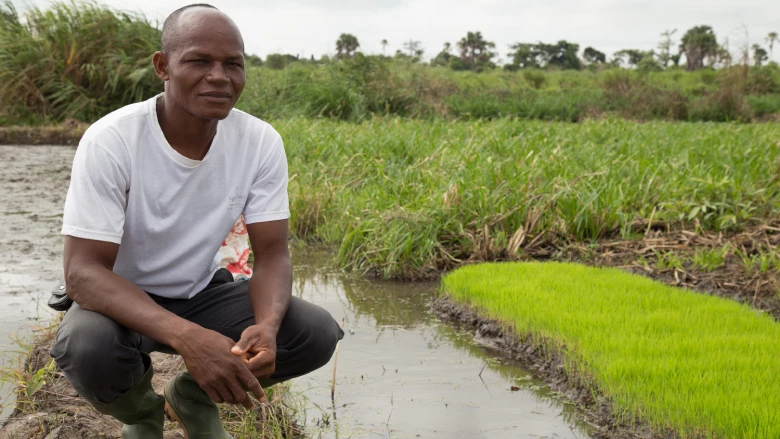
 The West Africa Agriculture Productivity Program is building a sustainable and nutritious food system in Cote d’Ivoire that creates jobs and produces nutritious food for farmers to sell and people to eat. Photo: Dasan Bobo / The World Bank
It is well known that agriculture is central to jobs and poverty reduction. The sector employs about a quarter of the world’s workers and nearly six in ten in low-income countries. It is also very well known that farms depend critically on water, and that most of the world's freshwater reaches fields as rainfall, which underpins jobs and livelihoods at a massive scale.
Yet few realize that much of this rainfall comes from forests.
For most of modern history, the mainstream belief was that rain came primarily from ocean evaporation. It took a Brazilian scientist named Eneas Salati to show otherwise. In the 1970s, Salati used the fact that water carries isotopic signatures as it evaporates, condenses, and falls. Tracing these signatures in rainwater samples from the Atlantic coast to the Peruvian border, he found something striking: nearly half the Amazon's rainfall came from the forest itself.
Trees draw water from the soil through their roots and release it as vapor through their leaves. This is termed transpiration and is the arboreal equivalent of sweating. This vapor rises, forms clouds, and falls again as rain, sometimes hundreds or thousands of kilometers downwind, steered by prevailing winds. Today, we know that globally, land-based vegetation — largely forests — contribute, on average, 45% of all rainfall on land, making it as important as ocean evaporation for sustaining rain.
Degraded forests, diminished rainfall
Forests, however, are fast disappearing. This has significant consequences for rainfall, for agriculture and for the millions of jobs dependent on flourishing farms. In the tropics alone, over 2.5 million square kilometers of forest have been lost since 2001 — an area larger than France, Germany, Spain, and Italy combined.
New research from Reboot Development quantifies the consequences on the hydrological cycle and the impacts on the economy. Without upwind rainforests of the Amazon, Congo and Southeast Asia, total economic losses from deforestation-induced rainfall loss could reach $11.4 billion in South America, $2.5 billion in Southeast Asia, and $0.4 billion in Africa on an annual basis. These losses span agricultural productivity, hydropower generation, and broader economic growth.
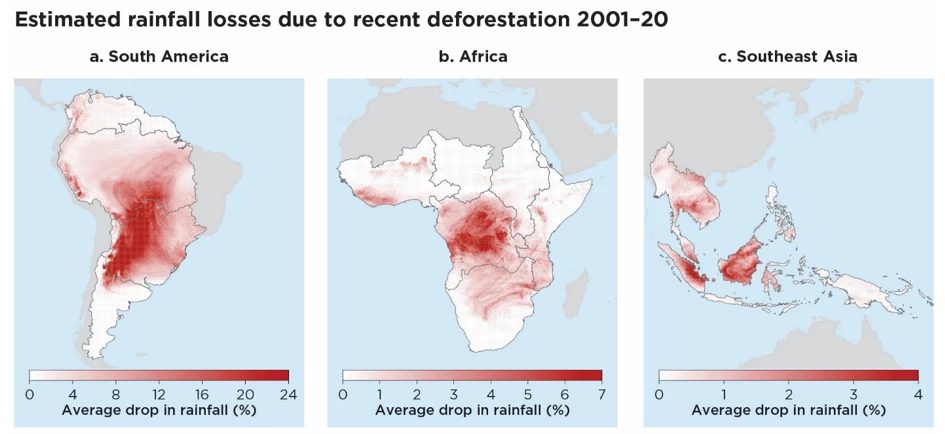 Source: Chapter 2, Reboot Development: The Economics of a Livable Planet
The damage is also deeply unequal. 40% of regions in low-income countries are highly dependent on rainfall recycled from forests, compared to just 2.4% of the wealthiest. And because moisture crosses borders, agricultural areas in 155 countries rely on forests in other countries for up to 40% of annual rainfall.
The hidden reservoir for farms
Once rain falls, where does it go? Most people assume it becomes the “blue” water we routinely manage — in rivers, lakes and aquifers — but this barely accounts for a third. The remaining two-thirds of rainfall over land becomes green water, stored as soil moisture in the root zone, which partly cycles back to the sky. Yet, this hidden reservoir of soil moisture is vastly neglected in decision-making, even as it sustains nearly 75% of global food production and fuels the transpiration that generates the next round of rain.
This matters for the livelihoods of roughly 500 million smallholder farmers, who produce a large share of the world's food. The World Bank Group's Agriconnect initiative aims to support them through a range of efforts from digital solutions to investing in skills to enhancing access to markets. For many of these farmers, helping them make the connection between the choices they make, the soil moisture they can preserve, and the link to productivity and incomes will also be key.
Upstream forests sustain and renew this soil moisture. Their canopies slow rainfall, their roots channel it underground, and the organic matter they shed makes soil spongy enough to hold water and release it slowly — a natural reservoir that sustains crops long after the last rain.
New research from Reboot Development finds that without upstream forests to sustain soil moisture and shield economies from drought, economic losses across the developing world could reach $379 billion or nearly 8% of global agricultural GDP.
Moreover, not all forests do this equally: native, older and biodiverse forests are far more effective at retaining soil moisture than monoculture plantations. Natural forests are more than twice as effective as plantations in buffering the economic impact of droughts. In Burkina Faso’s drylands, for instance, evidence showed that even scattered native trees dramatically improve the soil’s ability to absorb and store rainfall, supporting crops, livestock, and rural livelihoods.
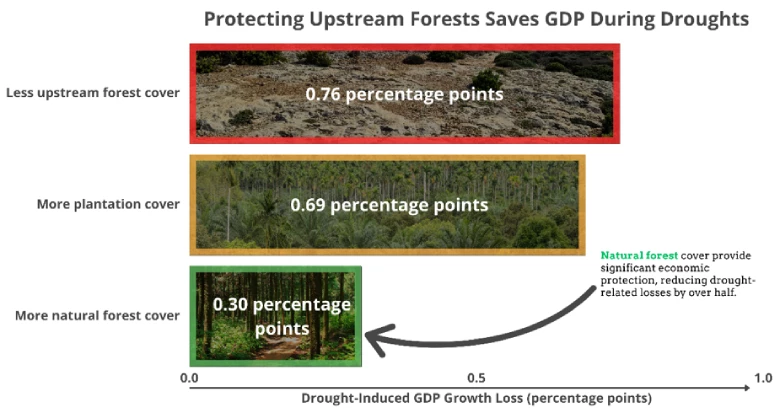 Source: Chapter 2, Reboot Development: The Economics of a Livable Planet
From root to rainfall
For developing countries that lack the fiscal capacity for costly water infrastructure, protecting, conserving and restoring forests offers a vital and cost-effective alternative that boosts agricultural productivity, supports energy generation, and stabilizes growth, with especially strong protective effects during extreme weather.
Importantly, it also creates jobs. High-labor ecosystem activities such as forestry and landscape restoration generate up to 38 jobs per $1 million invested, more than any other sector.
But getting it right is important because restoration done poorly can backfire. What and where you plant, matters. Tree planting that relies on single-species plantations can reduce biodiversity and disrupt the water cycle. Instead, restoration that works with nature — protecting intact forests, restoring with native species, allowing natural regeneration — consistently outperforms planting rows of the same trees.
Making this work will require policy instruments — from payments for ecosystem services to results-based restoration finance — alongside efforts that address the structural barriers driving deforestation. But it begins with recognizing that forests, soil, water, and the atmosphere work in concert. The links between them have long been underrecognized and undervalued in policy. The economic evidence suggests this can no longer be the case.


Join the Conversation