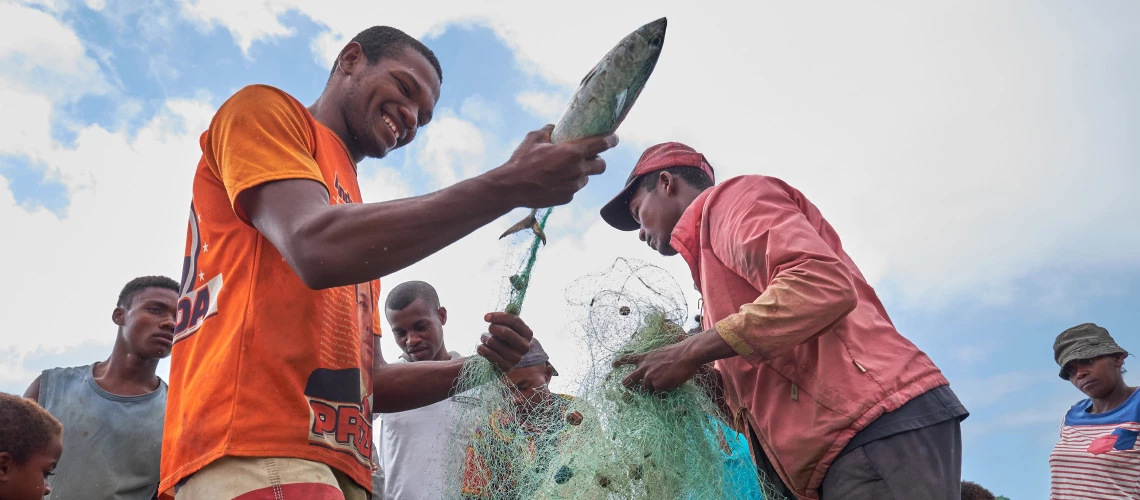
 Fishermen sort their catch in Maroantsetra, Madagascar. Photo: Mamy Nirina Razafindrakoto / World Bank
In an era defined by overlapping crises, from pandemic recovery and climate shocks to debt pressures and fragile conflicts, the global community often asks: Does multilateral development finance still work? Does it deliver where it matters most?
As we reflect on the just-concluded IDA20 financing cycle (2023–2025), the answer is a resounding yes. But the proof is not in the press releases; it is in the data, the stories, and the systemic resilience built across 78 countries.
Earlier, in February, we launched the IDA20 Retrospective, and the numbers tell a powerful story of scale. We mobilized $97.4 billion—nearly 28% more than the previous cycle—deployed with unprecedented agility. But as I’ve traveled and spoken with partners, I’ve emphasized that IDA is not merely a checkbook. It is a time-tested, transparent, and financially innovative instrument designed to tackle the most pressing challenges in low-income countries through impact.
Here is what the numbers actually mean in human and developmental terms.
First, IDA delivers at scale because it responds with both speed and sustainability. When COVID-19 threatened to erase decades of progress, IDA moved quickly to front-load support, helping countries maintain essential health and education services. But we didn't stop at emergency response. As Kalpana Kochhar of the Gates Foundation, a key partner in our work, noted, “IDA helped countries pivot from crisis mode to building resilient systems—strengthening primary health care, training community health workers, and upgrading labs and data surveillance. This dual approach—rapid response married to long-term institution building—is the hallmark of IDA’s model.”
Second, IDA goes where the need is greatest, particularly in Fragile and Conflict-affected States (FCV). During IDA20, we directed 89% of our resources to Sub-Saharan Africa and South Asia, home to 80% of the world’s poor. Critically, 40% of commitments supported countries affected by fragility, conflict, and violence. We reached nearly 200 million people in these challenging environments. This is not just about aid; it is about stability. As we have seen, building economic hope is a prerequisite for building peace. Without stability, there will be no long-term development.
Third, we are enabling infrastructure that underpins future economies. Development is impossible without power and connectivity. Through IDA20, we helped generate renewable energy and provided nearly 55 million people with new or improved electricity services. We have expanded internet access to 138 million people. Our private sector parters working on the IDA Private Sector Window, like Hans Olav Kvalvaag, CEO of Release by Scatec, highlighted, the PSW is critical here—offering guarantees to bring private capital into solar and battery projects in the least-developed countries, reducing dependency on expensive and dirty fuel alternatives.
Fourth, the "how" matters as much as the "how much." What makes me most proud is the IDA partnership model. As Nigeria’s Minister of Finance, Wale Edun, articulated so clearly, the relationship with IDA is "unique and multifaceted." It is not top-down. Countries bring their own ideas, their own priorities. We ensure that IDA financing aligns with national strategies, is affordable, and comes at scale in a timely manner. This country-led approach ensures ownership, which is the only path to sustainability.
Looking Ahead: The Jobs Imperative and Youth Engagement
The retrospective also served as a learning moment. We delivered, but we must evolve. A recurring theme was the centrality of jobs. We must ensure that our investments in human capital—health, education, and skills—translate into employment, particularly for a youth population that is growing exponentially in IDA countries.
Ndidi Okonkwo Nwuneli of One Campaign challenged us to move fast: youth must be at the table—in government, in business, and in our own operations. Just as gender is a cross-cutting lens, youth engagement must be integrated into everything we do in IDA21.
As Mavis Owusu-Gyamfi reminded us, at a time of pressure on global aid and rising debt, IDA represents a continued commitment to multilateral partnership. Done well, development finance can help realize our shared global future.
IDA20 proved that this institution can deliver with agility, transparency, and financial efficiency. Now, as we build toward IDA22, we are not resting. We are scaling impact, deepening partnerships, and doubling down on what matters most: creating jobs and building stable, secure, and growing economies for the billions who still look to us for hope and opportunity.
Join the Conversation