
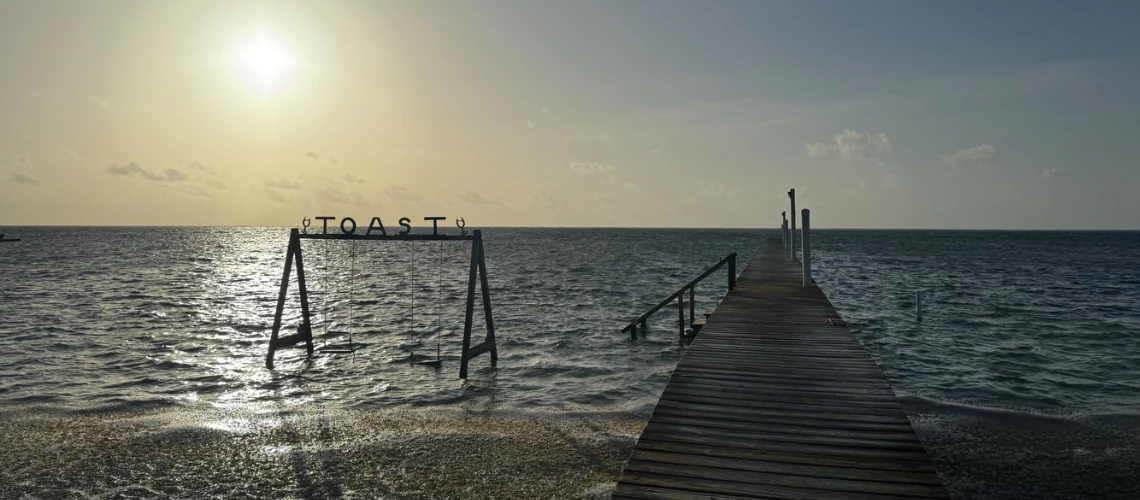
 When reefs degrade, the Caribbean loses its main tourism attraction, its fish stock and its first line of defense. Photo: World Bank Group
On a visit to Belize last year, we saw the tension up close: murky water near a coastline under development, and a few kilometers away, divers replanting coral on a reef that was in a fragile state of recovery. Those reefs aren't just beautiful. They are what tourists come to see, they are habitats for marine fauna, and they break wave energy that would otherwise batter shorelines during storms. When they degrade, the Caribbean loses its main tourism attraction, its fish stock and its first line of defense. Restoring them isn't just conservation. It's climate adaptation, food security, economic protection and, increasingly, a source of jobs.
When we think about job-creating infrastructure, we usually picture roads, ports, and power lines. Yet across Latin America and the Caribbean, some of the most employment-generating infrastructure is living: mangroves, wetlands, and urban green spaces that absorb floods and reduce heat. These natural systems don't replace traditional gray infrastructure; they complement it. And when countries invest in them, a larger share of the value stays local: creating work during construction and maintenance while protecting, and even expanding, the livelihoods that already depend on nature.
This pattern repeats across the region. From Patagonia's mountains in Argentina to the Caribbean's coral reefs, nature underpins employment in tourism, hospitality, agriculture and fishing. When ecosystems degrade, the impacts ripple through entire local economies. Evidence from World Bank–supported programs shows that nature-based solutions (NBS) are effective tools for reducing climate risk – and that they can also be job multipliers. Nature-based solutions create direct employment during restoration and maintenance, indirect jobs across ecotourism, fisheries and hospitality, and they safeguard existing assets by protecting communities from flooding and erosion.
The Bank’s recent report on NBS for beach stabilization and tourism, supported by the World Bank’s Global Facility for Disaster Reduction and Recovery (GFDRR), documents how restoring dunes, wetlands, mangroves, reefs, and seagrass can protect tourism assets while generating local jobs. Studies show that coastal NBS generate 15–33 jobs per $1 million invested: from cash-for-work mangrove planting that engages local communities, including women, to beach restoration that safeguards tourism and fisheries.
This plays out in cities, along coastlines, and in rural communities across the region.
In Fortaleza, Brazil, the city transformed degraded green spaces in flood-affected neighborhoods, including the 10-kilometer-long Rachel de Queiroz Park spanning more than 200 hectares. In one flood-prone sector that had become an illegal dumping site, a new wetland system of interconnected ponds now naturally cleans polluted water through bioremediation. More than 1,000 trees were planted, along with walking tracks, cycle paths, and leisure areas. Beyond reducing flooding and pollution, the project created jobs in construction, landscaping, maintenance, and community programming—stimulating local businesses and benefiting an estimated 70,000 residents.
In Medellín, Colombia, the Green Corridors program expanded urban tree cover to reduce extreme heat by more than 3°C. Employment was central to the model: the city specifically targeted vulnerable groups—many displaced by violence—and trained them for gardening and long-term maintenance roles, building local capacity alongside climate resilience.
Along coastlines, ecosystems are productive capital. In Belize, where employment is tightly linked to healthy reefs and beaches, World Bank–supported investments through the past Marine Conservation and Climate Adaptation Project and on-going Blue Cities Beyond Project combine reef protection, wastewater treatment, spatial planning (both from marine- and land-side), and monetization of carbon sequestration, to safeguard the natural assets that underpin tourism—diving, snorkeling, hospitality, transport—and the thousands of livelihoods that depend on them. These investments generate short-term work in restoration, medium-term positions in maintenance and monitoring, and long-term private-sector employment as stabilized beaches and protected reefs sustain visitor demand. In this way, Nature-based solutions do more than create jobs—they protect and improve existing ones by reducing the risk of ecosystem loss and increasing their productivity.
Nature-based work is also emerging as a way to channel income to vulnerable households. In Costa Rica’s Gulf of Nicoya, a marine Payment for Environmental Services scheme pays community associations for mangrove stewardship—tying income directly to ecosystem health and coastal protection while keeping value within the community. Similar approaches across the region link social protection programs with watershed management, urban greening, and coastal restoration.
One lesson stands out across these experiences: job creation is not automatic. It depends on design choices. Projects that deliver employment outcomes tend to measure jobs beyond construction—including operations, maintenance, and long-term roles—link NBS to training, social protection, and local procurement, and recognize ecosystems as productive assets that support entire value chains.
As governments across Latin America and the Caribbean face climate shocks, fiscal pressures, and demands for job creation, nature-based solutions offer a rare triple dividend: reducing risk, restoring ecosystems, and generating work where it is most needed. These are truly jobs that grow back.



Join the Conversation