
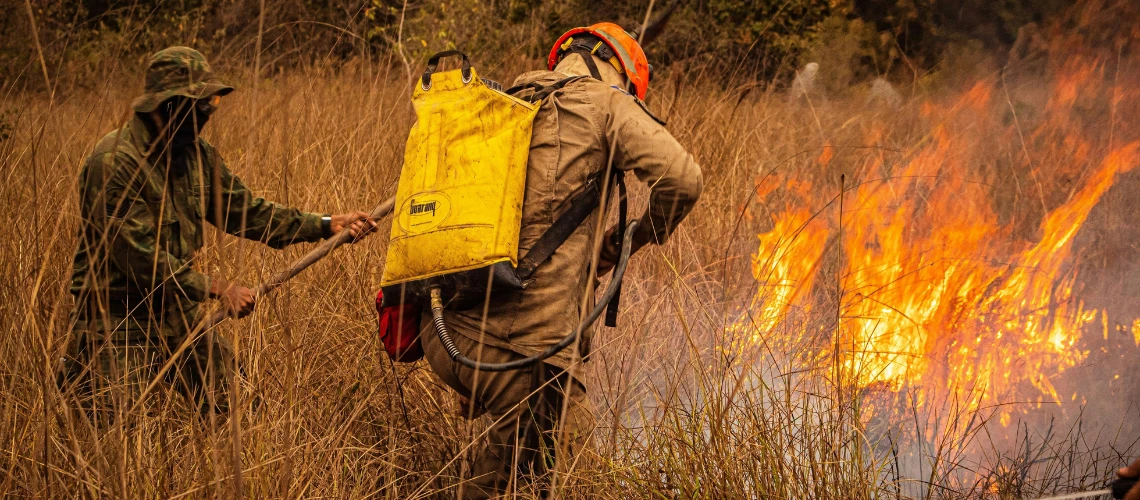
 Firefighters Battling Blaze in Mato Grosso Grasslands, Brazil. Photo: Pexels / Bombeiros MT
Over the past two years, our team has worked with governments and partners to move from crisis response to a smarter, data-driven approach that emphasizes prevention, preparedness, and resilience.
In Brazil alone, fires in 2024 imposed an estimated US$36 billion in damages—about 1.5% of GDP. The largest share of economic losses came from destruction of productive land, followed by greenhouse gas emissions and health impacts from smoke exposure.
A companion rapid valuation across the Amazon biome estimates US$43.1 billion in damages for 2024, including an estimated 14,622 premature deaths from smoke-related air pollution and 787 million tons of CO2e released—evidence that fires are both a public health emergency and a climate threat.
These numbers underscore a simple point: Investing in integrated fire management is not a cost; it is a prerequisite for economic stability, human health, and climate resilience.
Our strategy: From reaction to prevention
We built our fires management effort around three pillars that countries can adopt and adapt:
- Assessments to detect strengths and gaps in fire management systems. For them, we use a 5Rs (Review and analysis, Risk reduction, Readiness, Response, and Recovery) and 3Is (3Is: Information, Institutions, and Infrastructure -people and equipment) framework. Argentina assessment is guiding the government, and new work is underway at the subnational level, focusing on Patagonia provinces, which suffer from fires year after year.
- Valuation of damages to inform policy choices. Rapid valuations quantify the economic toll of fires. Brazil’s 2024 “burning bill” and the Amazon-wide damages study are already helping governments and partners raise awareness to prioritize budgets and policies that deliver the biggest social and economic returns. The method we develop combines spatial burned-area data with sectoral production values, a conservative carbon price, ecosystem services values, and epidemiological estimates of mortality from PM2.5 exposure—providing a replicable template for other countries. The latter was presented at COP30.
- Instruments for improvements. The new national fire policy in Brazil (Law 14.944/2024) is an example. Our analytics help operationalize this shift by showing where each “R” in the 5Rs delivers the highest return on investment. We are also translating diagnostics into practical tools to help countries rebalance resources from a suppression-heavy model to more prevention-oriented, cost-effective, and efficient approaches.
From analytics to action
- We are undertaking this type of work not only in Argentina, Brazil and the Amazonia as a whole but also in Bolivia, Ecuador, Mexico, and Paraguay.
We have financed this work with trust-funds: The rapid valuations were financed by Global Facility for Disaster Reduction and Recovery (GFDRR, TF0C3707) under the Regional Action Program to Protect the Amazon—demonstrating how small, targeted grants can unlock large-scale policy shifts and downstream investments. We worked under the World Bank’s Amazonia Viva platform and the Amazon Sustainable Landscapes Program financed by the Global Environment Facility (GEF).
Our teams have contributed to South–South exchanges and technical workshops to accelerate adoption of integrated fire management approaches, with FAO, OTCA, GIZ, IDB, among others. We participate in the FAO fire Hub Working Group on Fire Data.
Financing innovation: Bringing private capital to forest resilience
Public budgets alone cannot solve the fire challenge. In 2024, the World Bank issued a US$225 million, 9-year Amazon Reforestation Linked Bond that channels roughly US$36 million in upfront funding to a Brazilian developer for largescale native species reforestation on degraded land. Investors receive a fixed coupon plus a variable return linked to verified carbon removals (with Microsoft as an off taker), while principal is protected. The reforestation program also provides local co benefits resilience.
What’s different about our approach
Data-driven prioritization: By translating burned areas, smoke exposure, and land-use patterns into dollar terms, we aim to help counterparts rank interventions—e.g., fuel management, community readiness, early detection, and targeted suppression—by their expected benefits.
Whole-of-cycle management: Governments often face an “80/20” reality—most spending goes to suppression. We aim to help rebalance toward prevention and readiness without compromising response capacity, guided by international evidence of its advantage.
Integrated development lens: Our work sits at the nexus of health (air pollution), productivity (agriculture, livestock, and forestry), climate (emissions and sinks), and nature (ecosystem services). That enables stronger cross-ministerial coordination and more resilient public budgets.
What’s next
Our analytic work gives us a roadmap. By shifting from reaction to prevention, investing in readiness, and using innovative finance to crowd in new resources, countries can save lives, protect nature, and strengthen their economies.
From analytics to operations: Country teams are embedding findings from the rapid valuations and system diagnostics into new and ongoing operations—supporting prevention (fuel reduction, norms, incentives), readiness (training, equipment, evacuation planning), response (early detection and interoperable command), and recovery (restoration and livelihood support).
Economics of fires: We hope to prepare a regional knowledge series and dialogues—bringing finance ministries, environment agencies, and disaster management authorities together to align incentives and budgets around the most cost-effective measures.


Join the Conversation