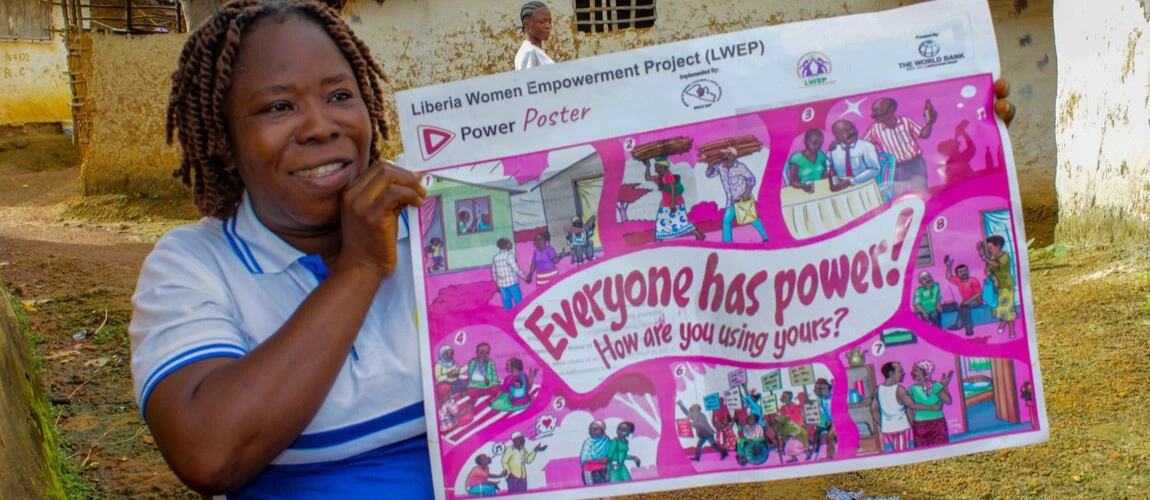
 Betty proudly carries her SASA! poster —a simple yet powerful tool she uses to spark dialogue and guide families toward peace and harmony in Morris Farm. Copyright: Ministry of Gender, Children and Social Protection in Liberia (MoGCSP)
On Morris Farm in rural Montserrado County, Liberia, Betty Moore walks through her neighborhood carrying a laminated poster with simple illustrations of household life: scenes of conflict, cooperation, and shared decision‑making. The images prompt conversations about power dynamics in the household.
Betty is one of 250 community activists supported by the Liberia Women Empowerment Project (LWEP). Her vision is simple but powerful: Morris Farm will be a place where women are safe and safety translates into the ability to work, earn, and thrive.
Betty’s effectiveness in facilitating dialogue comes from trust. She understands local dynamics, knows whom and how to engage, and recognizes when sensitive conversations require patience and privacy.
This local credibility is central to LWEP’s approach. Across participating counties, 155 community leaders and 250 activists are engaging women, men, traditional authorities, and religious leaders in dialogue on respect, partnership, and power dynamics, building the social capital that is foundational to inclusive, jobs-led growth.
The link between women’s safety and economic participation is significant in Liberia and underpins the World Bank’s vision to create more and better jobs. Over 55% of ever-partnered women in Liberia report experiencing emotional, physical and/or sexual violence by an intimate partner, though actual prevalence is likely higher given widespread underreporting. Evidence from multiple countries shows that an increase in GBV can reduce economic activities for women, and women who experience violence earn less than those who do not. Globally, GBV is estimated to cost countries up to 3.7% of GDP through lost productivity, reduced human capital, and increased demand for health and social services.
In Dougee Town, in Grand Gedeh County, the connection between women’s safety and economic opportunity came through powerfully during community sessions focused on women’s leadership and economic resilience. As one participant put it: "When a woman can stand on her own, people respect her more. This session helped us see that empowerment and protection go together.” During the session, women shared practical ideas for small businesses and discussed locally led solutions that can enhance safety, confidence, and autonomy, reflecting the same community-driven approach that anchors LWEP’s work across counties.
LWEP: Safety and jobs, together
Launched in 2022 with $44.6 million in World Bank financing and implemented by the Government of Liberia through its Ministry of Gender, Children, and Social Protection, LWEP combines community-led livelihoods programs with concrete pathways to jobs and economic opportunity, including livelihood grants, business trainings, health and education services, and activities to strengthen women’s voice and agency and challenge harmful social norms. The project deploys a community mobilization approach called SASA!—a Kiswahili word meaning “now,” which reflects the four phases of engagement: start, awareness, support, and action—across 498 communities, with the aim of reaching more than 200,000 women and men.
Global evidence shows that economic empowerment combined with social empowerment is one of the most promising long-term strategies for preventing GBV. LWEP is designed around this insight. The program has profiled over 3,800 enterprises, of which more than 875 received tailored support, and trained more than 1,000 beneficiaries, 83% of whom are women, in business and financial skills, equipping them with the knowledge to grow and increase income.
With support from LWEP, more than 400 business plans have been developed with value‑chain mapping and market‑linkage strategies, while 229 women‑led community groups have accessed over $708,000 in financing to boost productivity and create jobs in their communities. Broader lessons from this approach are shared in a recent blog, Five lessons from investing in women's economic empowerment in Liberia, which lays out the key insights shaping this work.
Strengthening systems for sustainability
Community-level change only holds if the institutions women turn to for safety, access to services, and economic inclusion are equipped to respond effectively. This is why LWEP is also investing in national systems. Capacity-building efforts extend across government, including training for health and education service providers in collaboration with relevant ministries.
In Gbarpolu and Grand Gedeh counties, school-based clubs engage girls and boys in safe spaces to discuss education, aspirations, and respectful relationships. The Ministry of Gender, Children, and Social Protection now operates a national GBV call center, providing psychosocial support and GBV response referrals across Liberia. The project is also mapping service providers and identifying gaps in GBV and adolescent sexual and reproductive health services to strengthen referral pathways.
Looking ahead
Addressing GBV alongside women's economic empowerment helps remove key constraints to inclusive growth and unlock women's ability to work, earn, and build sustainable livelihoods. LWEP will continue to work with the Ministries of Health and Education to strengthen services, sustain and expand community engagement for transforming attitudes, and support women's economic and social empowerment at every level. When safety and opportunity advance together, and when communities are supported to lead change, the benefits extend beyond individual households—strengthening local economies, creating jobs, and building the foundation for inclusive growth.


Join the Conversation