
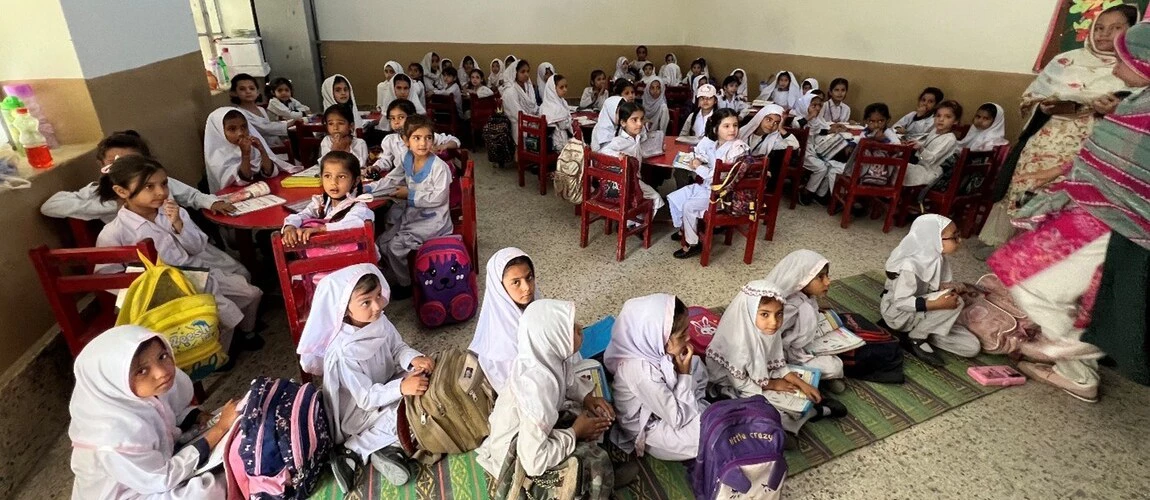
 Classroom in Balochistan, Pakistan. May 2024. Copyright: Inga Afanasieva/World Bank
When classrooms are already overcrowded and children are still waiting to enroll, finding a solution is not straightforward. In Balochistan Province, Pakistan, some schools have adopted shift systems, where the school day is divided so that different groups of students use the same classroom at different times of day. The tradeoff is significant: Each student receives less instructional time, but more children can attend school and overcrowded classrooms are avoided. It is a pragmatic response to a persistent constraint, and one the World Bank Group is actively supporting.
The Getting Results: Access and Delivery of Quality Education Services in Balochistan Project is supporting the introduction of double-shift schooling across the province. This support includes infrastructure upgrades, teacher training, and catch-up programs for out-of-school children returning to school as capacity expands.
A global challenge: Overcrowded classrooms
Balochistan is not alone in facing the issue of large classes. Across the world, millions of students are in overcrowded classrooms, stretching teachers’ ability to provide quality education. Data from the World Bank’s Global Education Policy Dashboard (GEPD) highlights the scale of the problem: In Chad and Sierra Leone, more than 100 students may be packed into a single classroom, while in Jordan and Bangladesh, maximum class sizes reach 60 and 92 students, respectively (figure 1). Such conditions make it difficult for teachers to offer individualized attention, manage classroom behavior, and provide engaging learning experiences.
Figure 1. Class size distribution and maximum, grade 4, selected countries
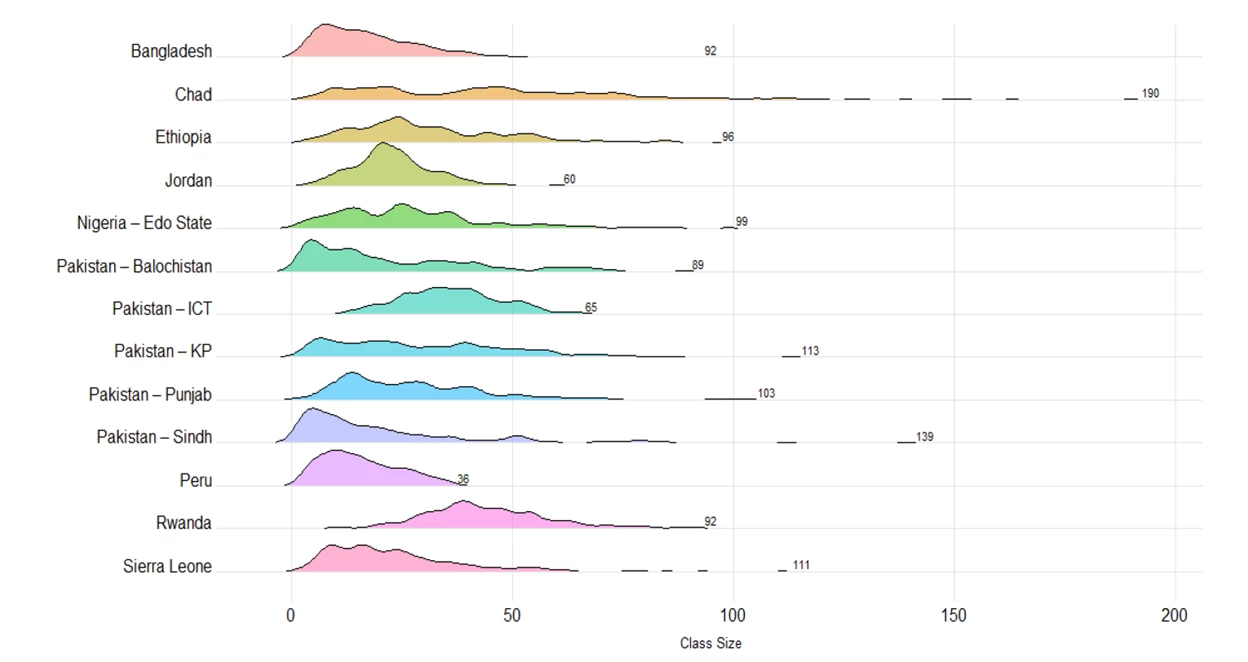
Source: World Bank Global Education Policy Dashboard.
Note: Preliminary estimates based on a randomly selected, representative sample of 200–300 schools in each country or region (100 in Pakistan - Islamabad Capital Territory). Data years: 2024 (Bangladesh), 2023 (Chad, Nigeria - Edo State, Pakistan regions), 2022 (Sierra Leone), 2021 (Ethiopia), 2020 (Rwanda), 2019 (Jordan, Peru).
These challenges—and promising approaches to address them—are examined in our new Working Paper and companion Education Note.
Teacher creativity is helping students learn despite large classes
Despite these challenges, teachers are finding creative ways to help children and youth learn. Quick assessments—such as brief Q&A sessions, peer reviews, or finger tracking during reading—allow teachers to gauge student understanding in real time. While it’s not possible to give individualized attention to every student, these checks help teachers target their support where it’s needed most.
Visual aids, such as charts, videos, flashcards, and physical models, can help maintain attention and clarify complex concepts, especially when space is limited. Teachers also use student-led activities, flipped classrooms (where students review content at home and use class time for practice and discussion), and rotational learning stations to make learning more interactive and personalized.
Collective action: How schools and communities can help
Schools and communities are mobilizing to support students in large classes. Additional adults—whether trained staff, community volunteers, or student teachers—can act as teaching assistants, working with individual students or handling administrative tasks so teachers can focus on instruction.
Collaboration is key: Team teaching, mentoring from senior teachers, and support from assistant teachers or volunteers help teachers share strategies, distribute workloads, and better manage large classes. Parents and guardians also play a vital role by reinforcing learning at home to bridge gaps caused by overcrowded classrooms.
System-level actions strengthen education under pressure
Improving learning outcomes in large classes requires more than classroom strategies—it demands structural solutions. Preparing teachers for large-class contexts, protecting time for lesson planning, and focusing curricula on foundational skills can enhance learning even when class sizes remain unchanged. Broader policies—such as equitable teacher recruitment and distribution, infrastructure expansion, and ensuring fair access to quality education—are essential for long-term progress. These investments are critical for building the skills and capabilities that shape young people’s productivity, earnings, and participation in the labor market over time.
While teachers, communities, and policymakers are showing that learning is possible even in large classes, temporary measures such as shift systems and creative teaching strategies cannot replace systemic investment. For education to truly thrive, systems must invest in teacher preparation, ongoing professional development, and school-level support, while working to reduce class sizes to sustainable levels.
The need for rigorous research—and a call to act on it
There is a critical need for more empirical research on what works in large classroom settings. Evidence on the effectiveness of different strategies, their adaptation to specific contexts, and their long-term impact remains limited. By studying classroom, school, and system-level approaches, education systems can make better decisions about how to prepare and support teachers and school leaders, and allocate resources.
The Working Paper and Education Note offer a starting point, but they also surface how much remains to be learned. Ultimately, systems must work toward reducing the prevalence of large classes, and in the meantime, build and act on the evidence needed to support the best possible learning outcomes for every child.



Join the Conversation