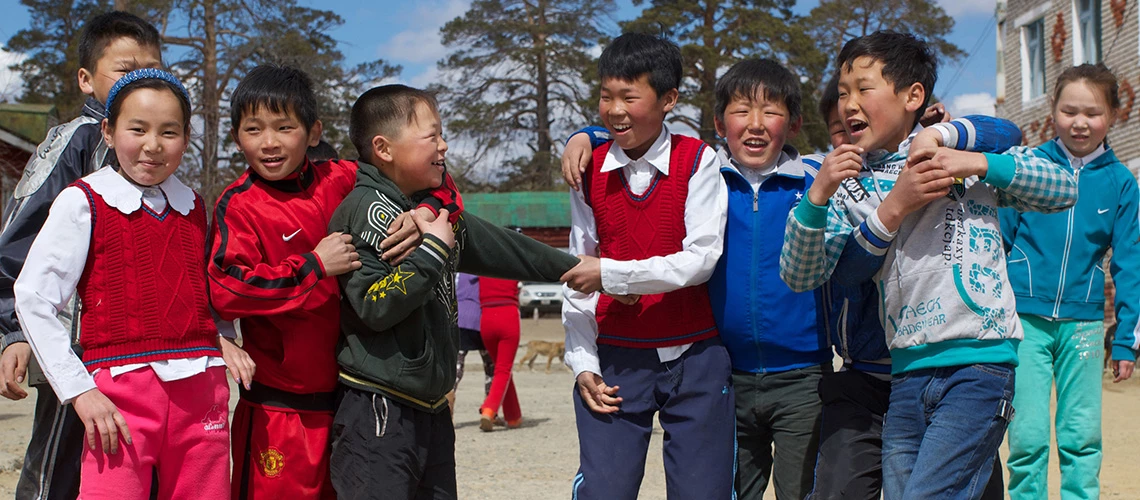
 Children playing, Mongolia. | © Khasar Sandag / World Bank
Child investment accounts seeded with government funds are generating significant interest among policymakers around the world. Mongolia offers a compelling and underexplored case study: a middle-income country that has operated such a program for two decades, with striking results.
Established in 2005, Mongolia’s Child Money Programme (CMP) provides monthly payments to all children aged 0-17 across the country — each month, children receive MNT 100,000 (equivalent of about $30) deposited into an account in their name. Mongolian banks recognize this program as a stable, long-term source of capital and offer specialized children’s savings accounts. Around one third of households have their child money payments deposited directly into these accounts. In exchange for keeping the funds deposited, children’s savings accounts earn interest rates between 11-13% annually (the market rate for term deposits).
The main financial advantage of these products lies in the option for automatic rollover of deposits at maturity, which allows interest to compound over time, a feature not included in other term-deposit accounts. While early withdrawals are permitted, families who withdraw early forfeit nearly all accrued interest, creating a strong incentive for long-term savings.
While Mongolian banks do not publicly track whether these term deposits are continually rolled-over until the child turns 18, data from the Bank of Mongolia show that since 2021, outstanding balances of children’s savings increased by 20 percent to reach MNT 3 trillion ($840 million) in 2024, equivalent to over 8% of the total banking sector deposit. This data does not allow for a granular child-level analysis in terms of long-term savings accumulation, investment, or asset building, highlighting an important gap for future research and program monitoring to explore. Rigorous measurement and analysis of the long-term trajectory of these accounts could identify the specific design features and transfer amounts that drive outcomes.
Research points to several channels through which accounts shape financial behavior and well-being. Account ownership provides a foundation for reducing poverty and expanding opportunity: studies link it to higher savings, greater female empowerment, and improved agricultural productivity. Account ownership is also associated with greater financial resilience and an improved ability to withstand sudden, unexpected financial shocks. Beyond access alone, receiving payments into formal accounts builds financial capability through “learning by doing,” while watching balances grow over time can strengthen trust in financial institutions and encourage sustained engagement.
Mongolia's experience is consistent with these mechanisms operating at scale. According to Global Findex 2025 data, while only three quarters of adults have an account at a financial institution in low- and middle-income countries—many of which are wealthier than Mongolia—account ownership in Mongolia has been nearly universal (98% of the adult population) since 2021. Available data does not allow for a direct causal link between the Child Money Program and these outcomes; many factors shape financial inclusion at the country level, and isolating the contribution of any single program is inherently difficult. That said, Mongolia’s success is striking and these potential links warrant further investigation.
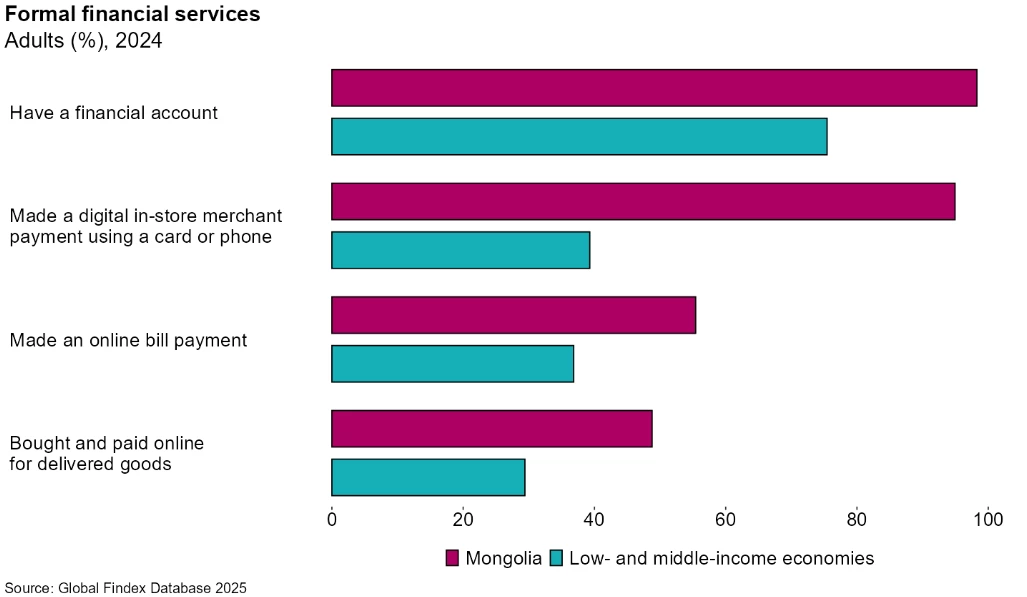
Ownership, however, is only the first step. Usage of formal financial services in Mongolia is also widespread (see Figure 1), supported by the digitalization of other government payments such as public wages, pensions, and social transfers, all of which recipients report receiving these payments into an account. As of 2024, 95% of adults in Mongolia make in-store digital merchant payments using a card or phone, more than half shop and pay online for delivered goods, and over 70% pay utility bills directly from their accounts. In comparison, across low- and middle-income countries just 39% of adults make digital in-store merchant payments, about a quarter shop and pay online, and 37% pay bills online. By global standards, Mongolia’s levels of digital financial engagement are exceptional.
Figure 1: Mongolian adoption of digital financial services is high
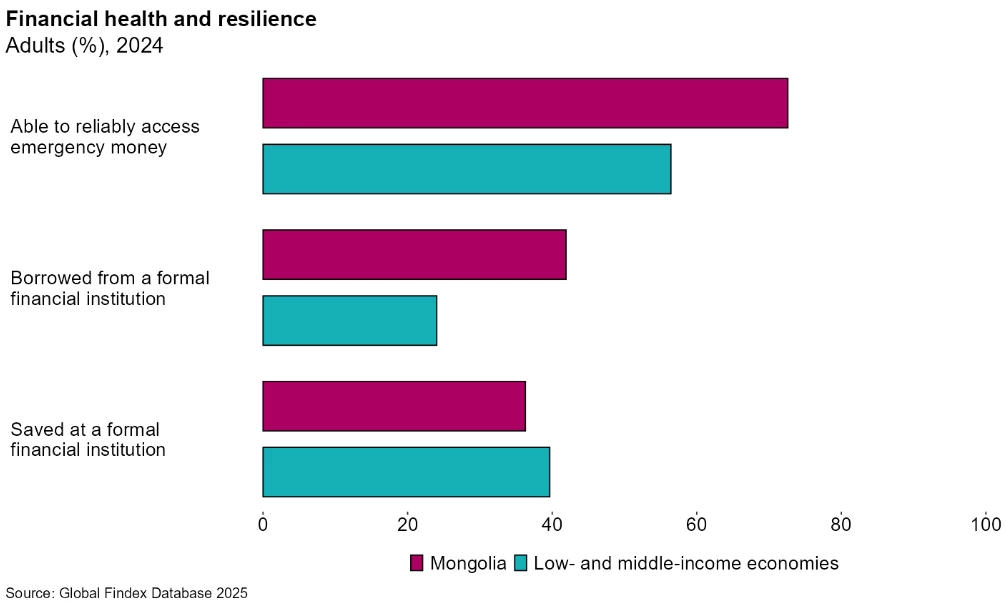
These high levels of account ownership and usage have meaningful implications for financial health and resilience. Mongolia demonstrates impressive financial resilience (see Figure 2): about 3 in 4 adults report that they could reliably access emergency money within 30 days, a rate among the highest in the developing world. This resilience may be linked to the country’s extensive use of formal financial services, including formal borrowing levels nearly twice the average for low- and middle-income countries and formal saving levels broadly in-line with other economies.
Financial resilience is especially critical in Mongolia, where extreme weather events—particularly dzud, devastating winter conditions—regularly threaten livelihoods. One in 4 adults report experiencing an extreme weather event within the past three years, and two-thirds of those affected lost income or property as a result. Notably, disaster-exposed Mongolians are just as financially resilient as those who have not experienced such shocks. The country’s robust digital financial ecosystem may be serving as an equalizer, equipping vulnerable households with the tools needed to manage financial emergencies.
Figure 2: Adults in Mongolia are highly resilient to financial shocks
Mongolia’s Child Money Program is only one of several national efforts to expand financial inclusion, yet it suggests how early account ownership, combined with active use, may translate into meaningful gains in financial resilience. The country’s experience suggests these accounts can offer more than seed capital—they can help build financial capability, strengthen engagement with formal institutions, and lay the foundation for long-term financial health.

Join the Conversation