
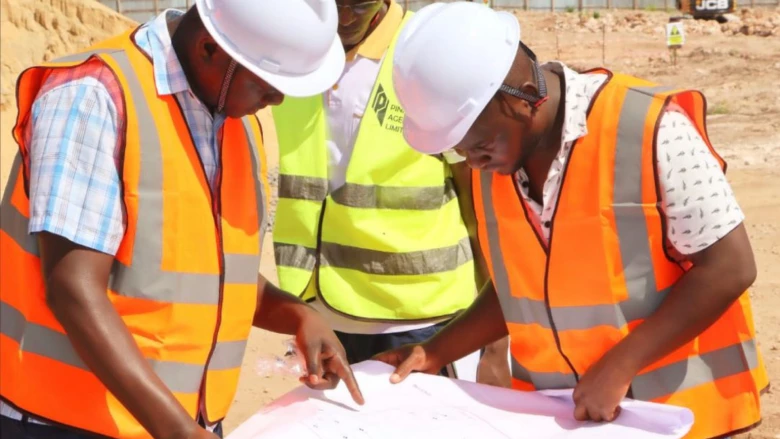
 Engineers scrutinizing design drawings at a wastewater treatment facility construction site. Photo: James Origa / World Bank.
Don't fix the pipes. Fix the institutions that fix the pipes. — Junaid Ahmad
Early in my career, I worked as a "street-level engineer," literally fixing pipes in the scorching sun with my own hands in rural communities across northern Kenya. At some point, I grew disillusioned. Despite being built to high technical standards, many of these water systems failed far too quickly. They were not failing because of faulty hydraulics or poor materials, but because the institutions responsible for operating, maintaining, and financing them were weak, fragmented, or misaligned.
It was around this time I stumbled upon a phrase attributed to Junaid Ahmad, the then World Bank Water Global Practice's first Senior Director: "Don't fix the pipes. Fix the institutions that fix the pipes." That mantra changed my career trajectory. It inspired me to re-skill and pivot toward changing the wider systems within which my pipes were functioning, hoping to build longer-lasting impacts for the communities I sought to serve.
The job-creation imperative
Recently, I had the pleasure of meeting Junaid — now Vice President for Operations at the Multilateral Investment Guarantee Agency — at the African Union Water and Sanitation Heads of State and Government Forum in Addis Ababa, where he moderated a solutions-focused exchange among African Ministers of Water on shifting the political economy of water at the national level.
This discussion could not have been more timely. With global aid shrinking and national fiscal space tightening, ministers for water face unprecedented pressure to justify every dollar they request from finance ministries. They must now demonstrate not just access results, but how public resources leverage private capital, strengthen institutions, and deliver measurable economic returns. This means driving reforms on tariffs, regulation, governance, and financial sustainability — and establishing institutions capable of investing in climate-resilient systems that catalyze jobs in agriculture, energy, cities, and industry. These reforms are no longer peripheral. They are central to keeping water high on the political agenda and positioning the sector as a driver of growth.
But can the pipe-fixers fix the institutions?
While "fix the institutions" provides a powerful reorientation away from infrastructure as an end in itself, it raises an uncomfortable question for a sector staffed largely by engineers: can the people trained to fix pipes actually fix institutions?
Some argue engineers should stick to the pipes and leave institutional reform to political scientists and governance professionals. Junaid and I debated this at the African Union Summit. We agreed that while most engineers often lack formal policy and governance training, the intellectual architecture of engineering and the intellectual architecture of governance are far more alike than either discipline acknowledges. My own decade of experience in policy-making and institution-building suggests the answer is a resounding yes.
Anticipating failure
Consider Failure Mode Analysis, a core concept taught in engineering school. Its logic is straightforward: before deploying a system, systematically identify every way it might fail, then design components to prevent those failures. Good policy designers must do exactly the same. Where will a reform encounter political resistance? At which point in the principal-agent chain will incentives misalign? Which stakeholders stand to lose, and how organized will their opposition be? These are not vague political questions — they are failure mode questions, demanding the same anticipatory thinking an engineer applies before commissioning a water treatment plant.
Systems thinking: The common language
Engineering is fundamentally about understanding complex systems: how components interact, how feedback propagates, and how non-linearities produce outcomes no single part could predict alone. Governance operates by the exact same logic.
A water engineer who manages a pipe network already understands this intuitively. A water network is not just a collection of pipes; its behavior emerges from the interaction of pressure, flow, and demand across the system. The institutional system governing that network works similarly — substituting human actors for physical components. The utility manager, the regulator, the municipal finance officer, and the community water committee are nodes in a governance network. The flows between them — of information, accountability, money, and authority — determine whether the system delivers, just as surely as hydraulic gradients determine whether water reaches the tap.
Feedback loops and continuous learning
Feedback loops are also native to engineering. Control systems engineering is built entirely on the principle that a system's output must be continuously measured and fed back into its inputs to maintain performance. The argument that institutional reform must build in mechanisms for continuous learning — that policy should elicit feedback from implementers and adapt accordingly — is structurally identical. Engineers do not find this idea novel; they find it obvious.
Breaking down the silos to build institutions that last
What I have observed repeatedly is a paradox: governance challenges are routinely framed in ways deeply familiar to engineers, yet the profession is rarely invited to recognize itself in that framing. Systems thinking, iterative design, failure analysis, stakeholder risk management — these are already in the engineering toolkit. They simply need to be recognized and deliberately applied.
The evidence makes the stakes unambiguous. The 2024 Water Security Financing Report shows that governance effectiveness, regulatory quality, and the performance of political institutions are all positively correlated with water sector budget execution rates. Fix the institutions, and the money flows more effectively too.
Global experience applying the World Bank's Policy, Institutions and Regulation (PIR) framework consistently shows that appetite for reform often lies outside the water sector — requiring champions at the level of Finance Ministers and Heads of State. This is precisely the logic behind the World Bank Group's newly launched Water Strategy Implementation Plan, which places country-owned Water Compacts at the center of its approach. These are not infrastructure plans — they are institutional commitments to water laws, independent regulators, and financially sustainable service providers, made at the highest levels of government.

Join the Conversation