
 Despite hundreds of gender indicators, key gaps remain in measuring women’s real economic outcomes—particularly in informal work, digital access, and supply chains. / Image: Shutterstock
Gender data has come a long way. We can now compare women’s labor force participation across countries, track legal reforms that affect women’s work, and see how many women sit on boards or work in certain firms. Yet the uncomfortable truth is this: we are measuring women in the system far better than we are measuring whether the system is working for women.
A recently published International Finance Corporation (IFC) report, Closing the Gap: A Private Sector Data Outlook on Women’s Economic Opportunities, highlights both the progress and the problem. The report maps where gender data exists and where it falls short. The bigger message, however, is not just that we need more data. It’s that we need better measurement, one that shifts from compliance to performance, from snapshots to trajectories, and from averages to lived realities.
The gender data paradox: more indicators, less clarity
The assessment identified 20 data sources that meet minimum thresholds for transparency, comparability, and relevance to private-sector decision making. These sources provide 429 indicators, covering an average of 129 countries over roughly 18 years. That sounds like abundance.
But here’s the paradox: as the number of indicators grows, actionable clarity does not always improve. Why? Because availability is not the same as adequacy. Many indicators tell us what exists (a policy, a disclosure, a headcount), but not what changes (women’s outcomes, mobility, safety, productivity, or constraints over time and the underlying social norms that shape these outcomes). And the areas that matter most for modern businesses, including supply chains, digital access, care systems, and gender-based violence affecting women’s ability to work, remain among the least measured.
What is measured well: formal systems and visible firms
The report’s strongest themes, including employment, leadership, flexible work & care, equal pay, and capital, share a common feature: they are easier to observe through official structures.
Public sources like the International Labour Organization; UNESCO; International Telecommunications Union; the World Bank’s Women, Business and the Law; and the International Monetary Fund’s Financial Access Survey offer broad geographic reach and extended covered period. Proprietary datasets like Bloomberg and Equileap can provide granular firm-level information, particularly for listed companies with reporting obligations.
This structure is valuable. It allows benchmarking, tracking reforms, and identifying broad gaps. For the private sector, it enables early screening and high-level targeting. But it also creates a systematic bias: what’s measurable often reflects what is formal, documented, and already visible to markets.
What we still miss: informality, enforcement, and intersectional reality
Gaps in gender data don’t just limit insight; it quietly reshapes whose experiences count and whose realities remain invisible. Corporate gender data is often voluntary, which means leaders tend to disclose while laggards remain invisible. Coverage is also skewed toward large market capitalized firms, leaving SMEs, informal businesses, and micro-enterprises where many women work largely out of view.
Even where data exists, it often lacks intersectional detail, masking differences by age, occupation, sector, or industry. And too much emphasis remains on de jure measures (laws and policies on paper) rather than whether they are enforced or translated into real outcomes.
These shortcomings are reflected clearly in the coverage scorecard (see the table below): capital stands out as the only theme with strong coverage across indicators, countries, and time, while supply chains and digital access remain among the least measured and least consistent areas.
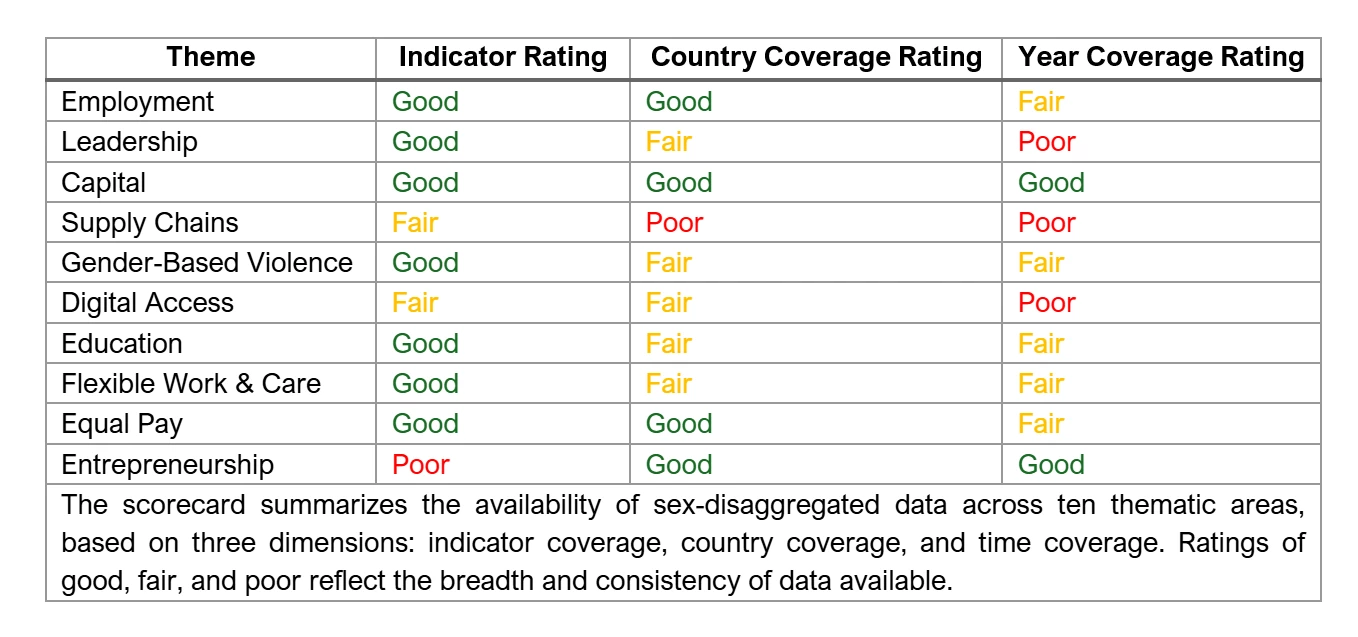
The implication of this is straightforward: gender equality cannot be managed like a reporting exercise. If we keep measuring only what is easy, such as large firms, formal jobs, and policy presence, we risk building strategies that look good in dashboards but fail in real economies.
A shift in measurement: from reporting to decision intelligence
If gender data is going to improve women’s economic participation, it needs to evolve. The report puts forward practical recommendations to close these gaps.
First, gender data should be treated like market infrastructure. Just as investors rely on standardized credit data, decision-makers need gender indicators that are comparable, consistently collected, and clearly defined across sources, including proprietary datasets. This is essential for advancing gender-lens investing and innovative financial instruments such as blended finance, gender bonds, social bonds, risk-sharing guarantees, performance-linked loans, and sustainability-linked loans which depend on robust data to set benchmarks and track outcomes.
Second, coverage must come with credibility. More indicators do not automatically mean better insight. Expanding data coverage should go hand in hand with third party verification, auditability, and alignment with ESG assurance standards, so users can trust what the numbers are saying.
Third, measurements need to extend beyond large, listed firms. Women are heavily represented in SMEs, supply chains, and informal enterprises, yet these spaces remain largely unavailable in current datasets. Without measuring them, gender strategies will remain partial and skewed.
Finally, intersectionality should be the default, not the exception. National gender averages often mask the greatest constraints. Data that captures subnational differences, age, sector, occupation, or other demographic dimensions is essential to understanding where barriers are most binding and where action is most needed.
Closing the gap is not only about filling data holes. It is also about improving measurements so that women’s economic opportunities become not just visible but investable, trackable, and real.



Join the Conversation