
 The Human Capital Index Plus (HCI+) shows how health, education, and employment shape lifetime productivity and earnings—and where countries can unlock higher future income through policy action.
How much of a child’s productive potential is lost during their working years, and what areas should governments target for improvement? The World Bank’s new Human Capital Index Plus (HCI+) was built to answer both questions, and a new interactive app makes the data easy to explore for anyone, from policymakers to researchers to curious citizens.
The HCI+ measures how much human capital a child born today can expect to have through their working life, given the risks of poor health, education, and employment that prevail in the country where they live. It combines rigorous evidence on the impacts of health, education, and employment outcomes on productivity with globally comparable indicators to produce an index directly related to labor productivity and earnings.
If you’re new to the HCI+, here’s what makes it different from earlier versions: while the original Human Capital Index tracked child development only up to age 18, the HCI+ extends the horizon to age 65. That means it captures new indicators on tertiary education and youth and adult on-the-job learning. It also introduces a new, intuitive scale: every 10-point increase corresponds to roughly a 10% increase in productivity and wages. This makes policy simulations simple, something that can be explored on the website and app.
Here are five things you can learn from the index, and from the app that makes it easy to explore.
1. The world’s earnings potential could rise by 50 percent through greater human capital, and you can see where the gains come from
The headline finding of the HCI+ is stark: children born today in low- and middle-income countries could raise their future wages by about 50 percent if they achieved the human capital outcomes of the top performers at similar income levels.
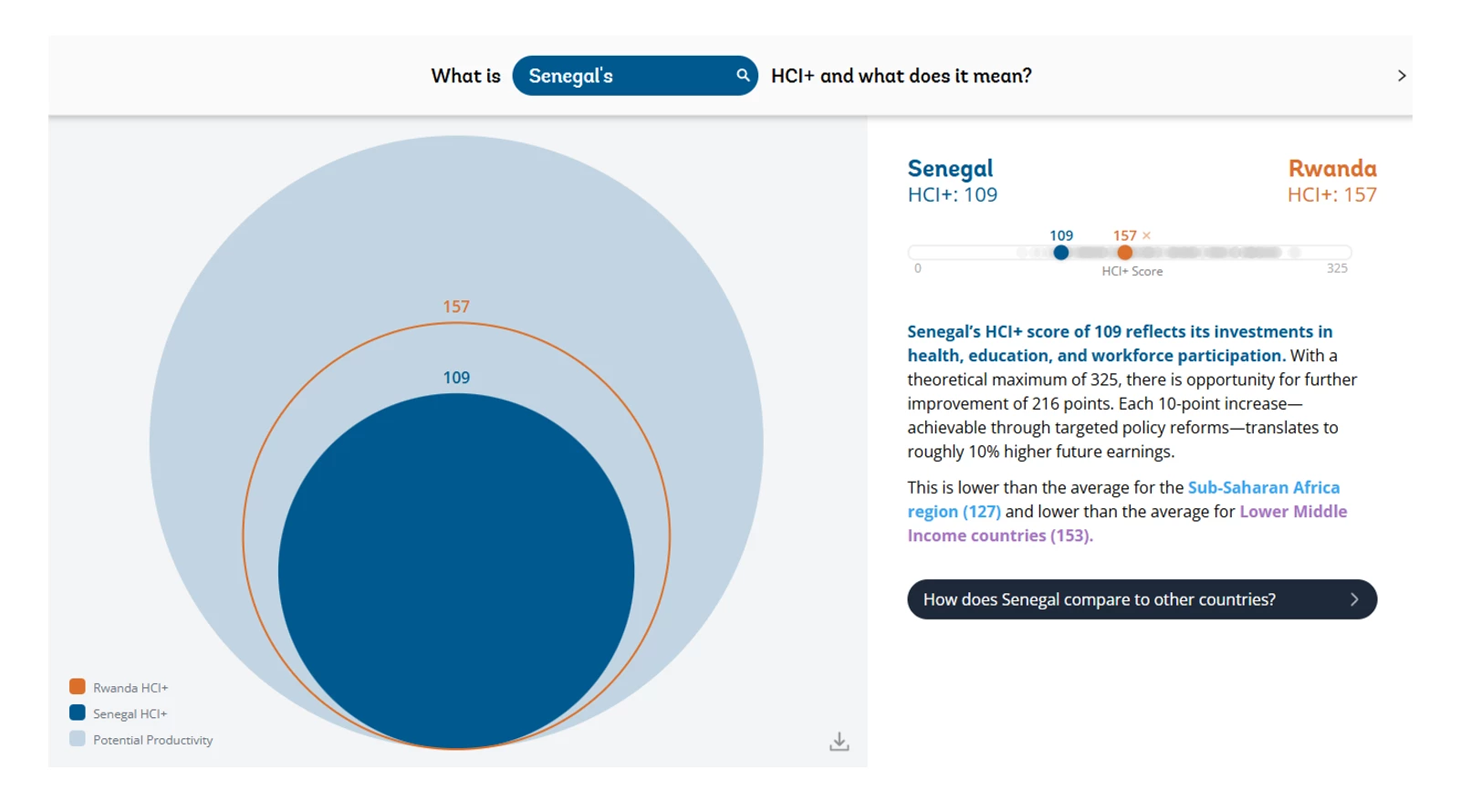
In the app: Use the HCI+ country insights to look up a country’s score and benchmark it against peers with similar GDP per capita. For example, if Senegal matched the human capital outcomes of Rwanda, for example, its future earnings potential could increase by around 50%. For many countries, matching the top performers at their income level, an ambitious but achievable target, could yield large gains.
2. The index includes human capital built at work
One of the most important innovations in the HCI+ is the inclusion of an on-the-job learning component, a feature no previous version of the index captured. Schooling matters enormously, but the skills people gain (or fail to gain) after they enter the workforce account for a large share of their lifetime earnings. Workers in wage employment accumulate skills at roughly twice the rate of those in informal self-employment. That gap shows up directly in the index.
In the app: You can decompose any country’s score to see how much of its deficit is explained by education versus on-the-job learning. This is especially revealing for countries that perform well on schooling metrics but have potential workers out of the labor force or low levels of wage employment, a pattern the app makes visible at a glance. For example, Türkiye has similar outcomes in health and education compared to other OECD countries, but could improve on-the-job learning through employment. Matching adult labor force participation rates to that of other OECD countries could boost earnings by around 11% alone.
3. The gender gap in human capital is economically meaningful, and it’s largely a jobs story
What the HCI+ reveals: Globally, women’s HCI+ scores are about 20 points lower than men’s. Perhaps the most striking finding is where that gap comes from: not from health outcomes, and not mainly from schooling, areas where women and girls have made real gains, but from labor force participation and access to quality employment. Around half of women in low- and middle-income countries are outside the labor force. Those who do work are disproportionately concentrated in informal self-employment, where skill accumulation is slower and earnings are lower.
The implication is clear: closing the gender employment gap alone could increase potential earnings for women by as much as 70 percent in some countries, making it a major untapped economic opportunity for developing economies.
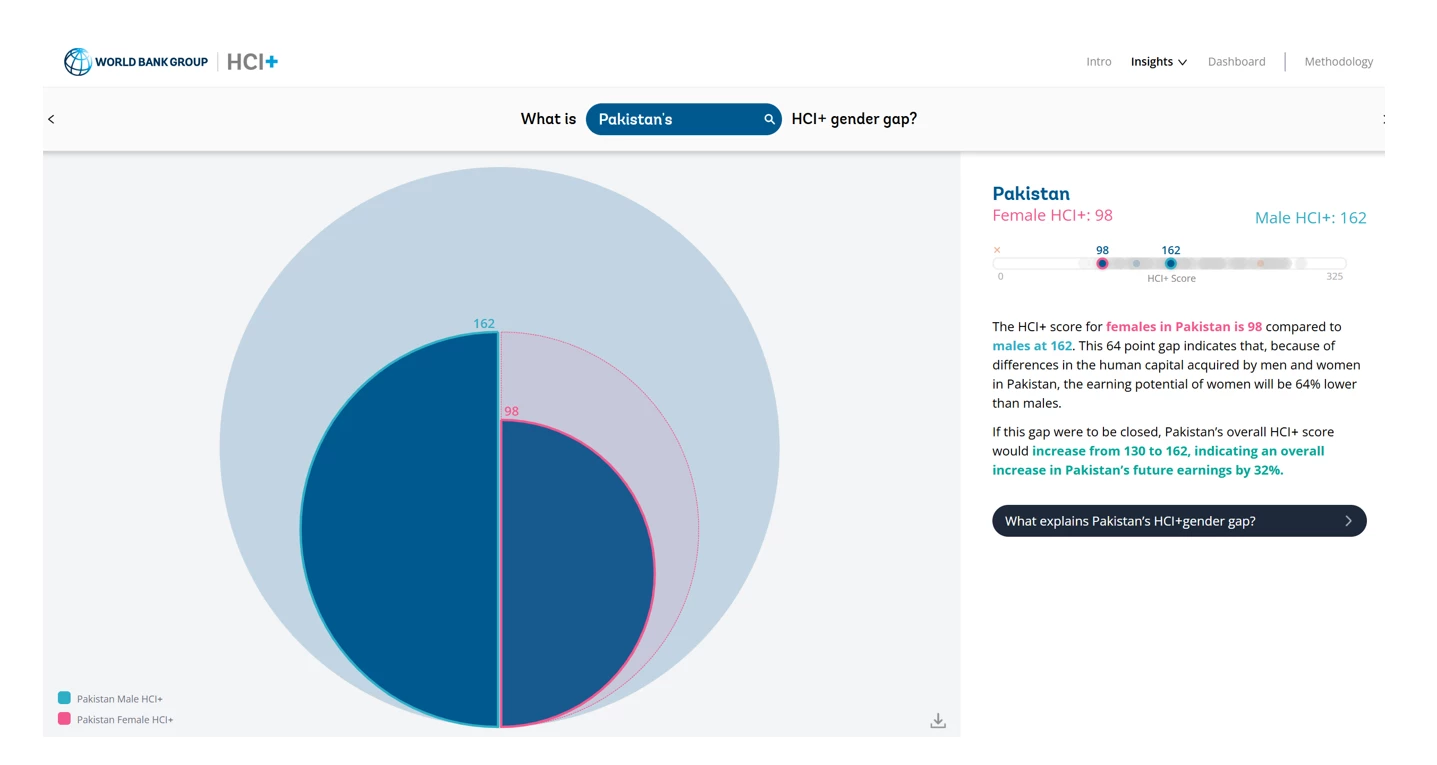
In the app: The HCI+ app includes gender-disaggregated scores for every country, and the interactive dashboard lets you toggle between male and female scores to see the gap and trace it back to its source.
4. Some countries are beating the odds
A key question for any policymaker is: what does “good” look like, and is it achievable? The HCI+ helps answer this by highlighting countries that significantly outperform others at similar income levels. Rwanda, Peru, Kenya, the Kyrgyz Republic, and Vietnam, for example, all perform well above what their GDP per capita would predict, evidence that strong policy choices around early childhood development, schooling quality, and labor market access can move the needle even without abundant financial resources.
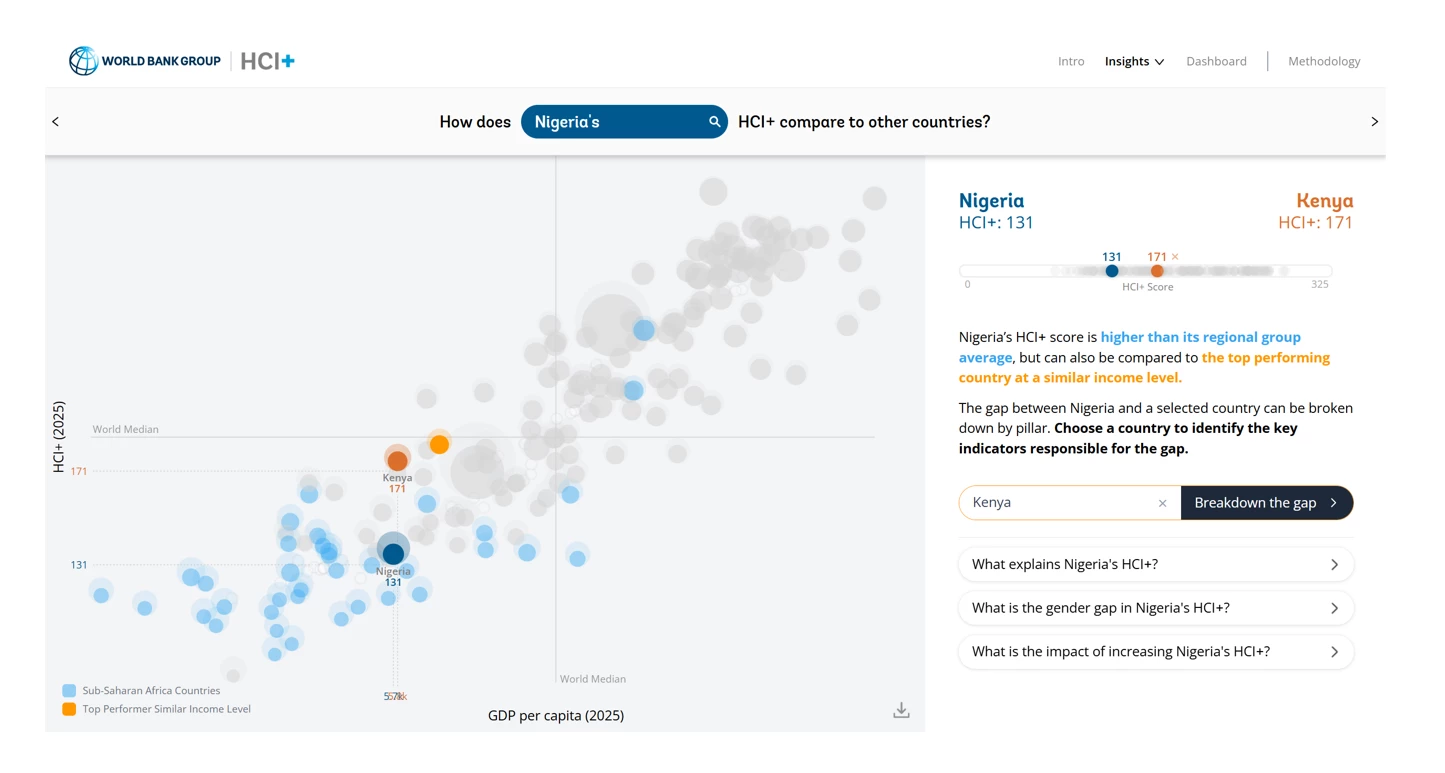
In the app: The country, regional, and income-group comparison tools let users benchmark their country against peers at similar development levels, not just against global averages. This comparison to best-in-class countries is more useful for policymakers than raw rankings because it points to what’s actually achievable given a country’s circumstances.
5. The app lets you simulate policy improvements
The HCI+ was designed from the start to be a policy tool, not just a report card. Its simulation feature allows users to model the impact of specific interventions: What happens to a country’s score if under-5 stunting rates fall by 10 percent? If school completion rates rise? If more people enter the workforce? The results, expressed in projected lifetime earnings gains, provide a data-driven way to prioritize investments.
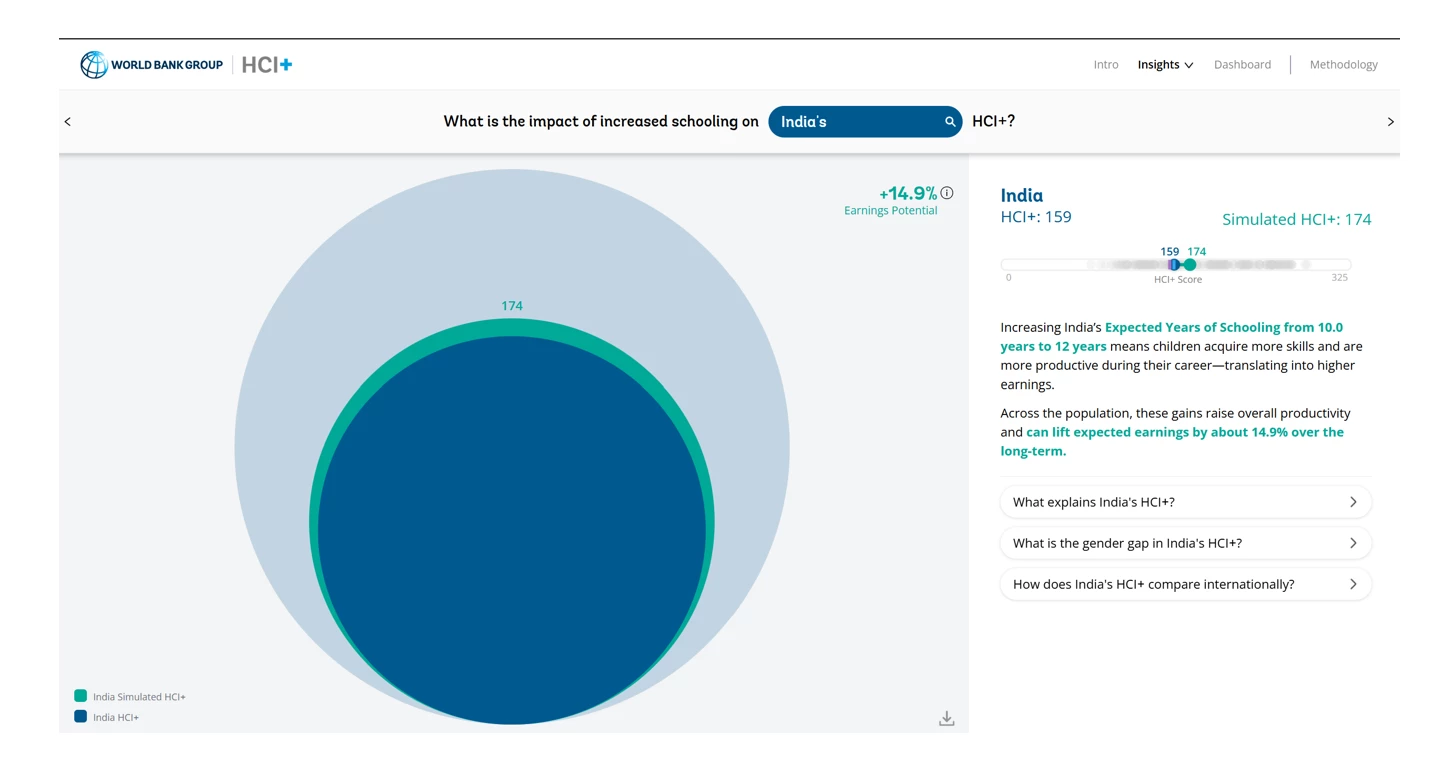
In the app: The simulation tool lets any user run these scenarios for their country of interest, choosing from a menu of health, education, and labor market interventions. The outputs update in real time, translating policy choices into their projected impact on the HCI+ score and on expected national earnings. For example, if India improved its expected years of schooling by two years, future earnings potential could rise by almost 15%.
To explore these patterns for your country, and to run the kinds of comparisons and simulations highlighted above, visit the full HCI+ website and app at humancapital.worldbank.org/hciplus. The site includes country profiles, gender-disaggregated scores, regional and income-group comparisons, methodology documentation, and the policy simulator. All underlying data are available for download and reuse.
The accompanying report, Building Human Capital Where It Matters: Homes, Neighborhoods and Workplaces, is available at worldbank.org/en/publication/human-capital-report.






Join the Conversation