What a journey it has been—and it’s far from over! Over the past decade, social protection programs in Madagascar have grown tremendously, transforming lives and livelihoods across the country. At the heart of this progress, we see that social protection is about helping families cope and about building the foundation for better jobs and sustained economic participation tomorrow. By protecting households from shocks, building skills, and restoring productive assets, these programs help women move from vulnerability toward opportunity, strengthening Madagascar’s long-term growth and employment outlook.
In a country highly vulnerable to climate and economic shocks, the path to decent work is often interrupted—by drought, displacement, illness, or sudden loss of income. For women in particular, these barriers can be deeply compounding. Social protection programs serve as a critical bridge, helping them get back on their feet and re-enter economic life. But they go further than that: by investing in skill development, financial literacy, and economic inclusion. These programs actively open new doors to income generation for women, building resilience and lasting economic growth that ripples through families and communities.
Back in 2014, we started with just 25,000 beneficiaries in a single region. By 2016, we had expanded to six regions. Today, we are reaching nearly 3.6 million people across all 23 regions—and if we include crisis response programs, that number rises to 7.2 million! One of the most inspiring aspects? Around two-thirds of those benefiting from these programs are women. We have seen firsthand how social protection empowers them, boosting their confidence, strengthening their resilience, and giving them the tools to shape their own futures. Whether through direct cash transfers, economic grants, or training and coaching, their empowerment is key to building stronger families and communities, unlocking women’s economic potential, and expanding pathways to jobs and income generation across the country.
Let’s dive into four reasons Madagascar’s social protection programs are focused on helping women on a pathway to a better future:
To enable women to rebuild their lives aftershocks and crises
Thanks to the Madagascar Social Safety Net Project and Madagascar Safety Nets and Resilience Project, implemented by the Government of Madagascar with support from the World Bank, women receive financial assistance, training, coaching, and awareness sessions. These resources do more than provide short-term relief—they help beneficiaries regain productive assets, re-enter economic activity, and rebuild their lives. By stabilizing families aftershocks, the programs prevent long-term setbacks in human capital and employment prospects.
Take Baosolo, Georgette, Mamileba, and Tamba in the video above. Through financial and technical support, they found the opportunity to start again after shocks and crises had stripped them of their assets or cost them their jobs. Today, they earn a living, provide for their children, and face the future with resilience and determination. Their journeys show how social protection can serve as a conduit—from crisis to recovery, and from recovery to sustained economic participation.
To enhance women's economic inclusion
Social protection programs in Madagascar equip women with skills and opportunities to improve their long-term prospects. Through training and economic support, they can engage in income-generating activities like agriculture, sewing, small businesses, basketry, and weaving.
Through our programs, women receive training in financial literacy, savings, and technical skills that enhance productivity while promoting environmental sustainability. In many households, cash transfers and economic inclusion subsidies are given to mothers to meet essential needs like education, nutrition, and healthcare, strengthening children's foundation and a chance for a better future and dignity.
To invest in women’s and girls’ education and health
Most of the women beneficiaries of the social protection programs have not had a chance to go beyond primary school. Our social protection programs help make up for that, providing literacy training and parental education, which helps mothers to better support their children’s schooling, all of this contributes to breaking the cycle of poverty. This investment in human capital is crucial: with 47% of children completing primary school, these programs are designed to encourage school attendance—especially for girls—leading to a 12-percentage-point increase in net school enrollment. Since 2015, programs have helped 338,811 girls enroll in school.
Investing in maternal healthcare is also crucial. Around 20% of women do not receive prenatal consultations or care, but through “well-being spaces,” provided by social protection programs, all participating pregnant women now receive essential prenatal care. Thanks to the awareness sessions and training on dietary diversification conducted in these well-being spaces, acute malnutrition among children aged 6 to 59 months has dropped by 5.4 percentage points. By improving education, health, and overall well-being, these programs ensure that they and their children have a stronger foundation for the future.
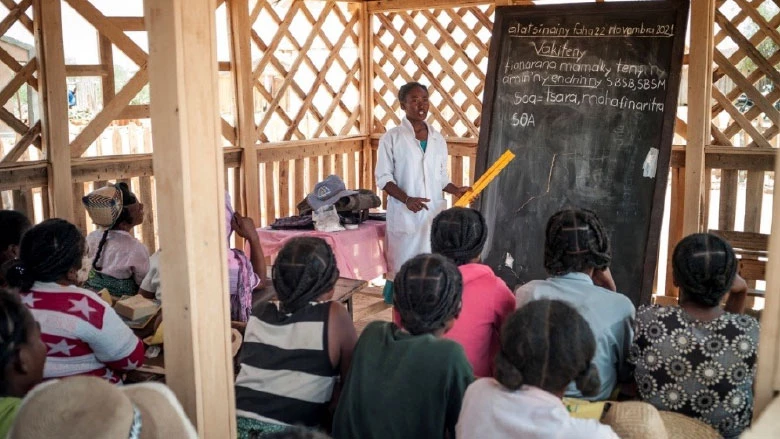
Literacy session for women beneficiaries of social protection programs. Photo: Henitsoa Rafalia / World Bank
To empower women as community leaders
Traditional system in Madagascar tends to exclude women from decision-making. But over the past decade, social protection programs have helped change this. Today, more than 20,000 Malagasy women have been trained as “Mother Leaders,” becoming role models and pillars of resilience in their communities. They play a key role in shifting behaviors and empowering others. They lead initiatives that improve education, healthcare, nutrition, and the fight against child marriage—helping shape a better future for their children and communities.
Take Volatsarasoa, from the village of Malangy in Ambovombe. She survived the devastating drought of 2016 in southern Madagascar and has become a Mother Leader, now mentoring 25 women and girls, passing on the life-changing skills she has learned. Together, they have created a savings group, invested in infrastructure to withstand droughts, and built a shared garden, growing nutritious crops that improve their families' diets and provide an income from surplus sales.
From the very beginning, we have witnessed the growth of Madagascar’s social protection system—seeing it evolve, make a real impact, and bring hope to so many, especially Malagasy women. When they receive the right support, they thrive. They uplift their families, strengthen their communities, and drive real, lasting change. Every step they take toward economic independence and resilience paves the way for future generations. Through social protection programs, we are empowering women and helping reduce poverty and support job creation. The more women we support, the stronger our communities become. And that’s a future worth investing in.
Join the Conversation