

Thousands of people work, solve problems, and care for others every day, but their skills often go unseen in the formal labor market. In Argentina, an AI‑powered employment pilot is beginning to change that by revealing a wealth of experience that up to now has remained invisible and helping people connect, often for the first time, with public employment services.
These insights emerged from the rollout of the app Poné tus habilidades a trabajar (“Put your skills to work”) that was integrated into two of Argentina’s largest labor market programs. When the pilot went live, it showed a large “invisible” population of older workers who had long operated on the fringes of the formal economy.
Nearly 85% of those who engaged with the platform were 25 and older, and more than half (55%) had never previously accessed program services.
Far from lacking skills, many of these workers had rich life experiences: years of odd jobs, family caregiving, community involvement, and everyday problem-solving that added up to a career’s worth of knowledge.
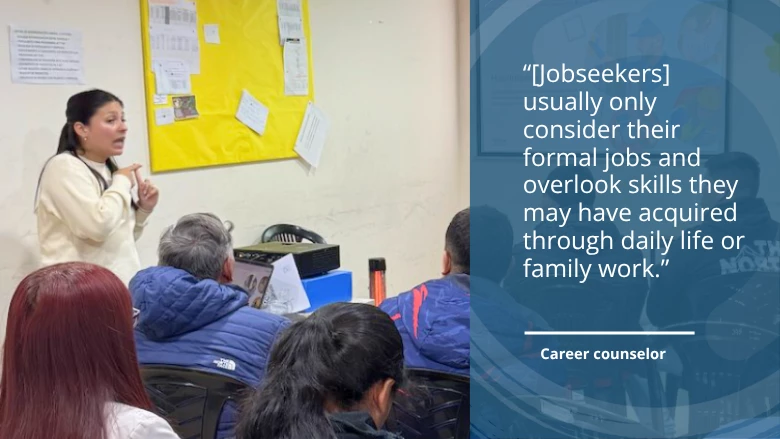
The app’s AI-enabled engine helped turn these experiences into a detailed profile, capturing dozens of skills per user that had never been recorded in any database or advertised in a resume. This depth only emerged when the app prompted users to share their experiences and systematically converted them into skills that employers – and the users themselves – would recognize and appreciate.
Despite (or perhaps because of) its reliance on the latest technologies, the Poné tus habilidades a trabajar app also demonstrated that AI doesn’t replace human employment services.
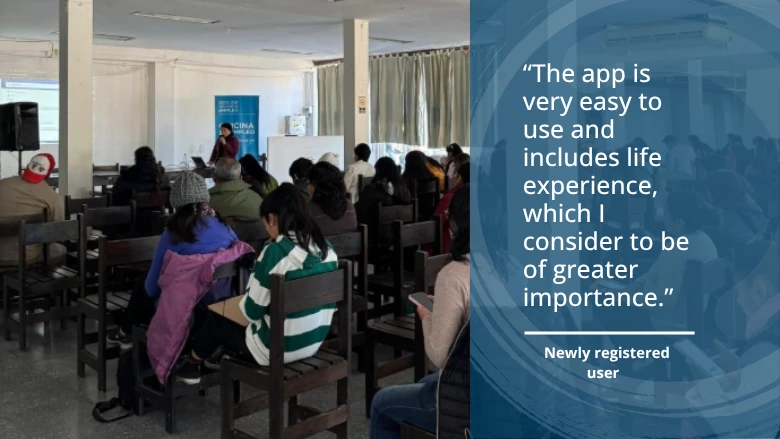
Users of the app required both trust and hands-on support to take full advantage of the tool. The trust was built with invitations to the app that came from recognizable government channels and with endorsements by local employment offices. From there, workshops and one-on-one assistance helped participants take full advantage of the app. By pairing an AI-powered profiling tool with trusted local employment offices and targeted outreach, the initiative made invisible profiles visible.
Key findings from the Poné tus habilidades a trabajar pilot:
Disconnected but ready to engage. About 55% of registered users had no prior interaction with active labor market programs. In some municipalities, engagement rates through the app reached 75%.
A rich set of skills brought into view. On average, participants discovered 42 skills each—38 for women and 47 for men—revealing a depth of competencies that had never appeared in administrative records or traditional CVs.
Life experience counts. Skills drawn from caregiving, community work, and informal activities accounted for roughly half of all identified skills, often surpassing those linked to formal jobs or education, especially among women.
Personalized career recommendations have further benefits. When users were given personalized job and training recommendations, including based on labor market demand, they added 8 additional skills to their profiles on average –a 50% increase compared to users who did not receive personalized recommendations.
About the Poné tus habilidades a trabajar pilot The pilot was undertaken in partnership with the Subsecretary of Employment and Training (STyFP) in Argentina. SkillLab developed the skills profiling and jobs intermediation tool. We also partnered with Lightcast to access online job postings data. For a deeper dive into the design, implementation, and operational lessons learned from this experience, see the Poné tus habilidades a trabajar lessons learned report. The pilot demonstrates how scalable, AI-enabled tools—implemented with a common standard across territories and anchored in local employment offices—can transform employment services by moving them beyond ad hoc judgments and registration systems. These tools map hidden skills into a shared labor-market language systematically, and in doing so help transform the invisible into a strategic asset for service design and policy decisions. |


Join the Conversation