
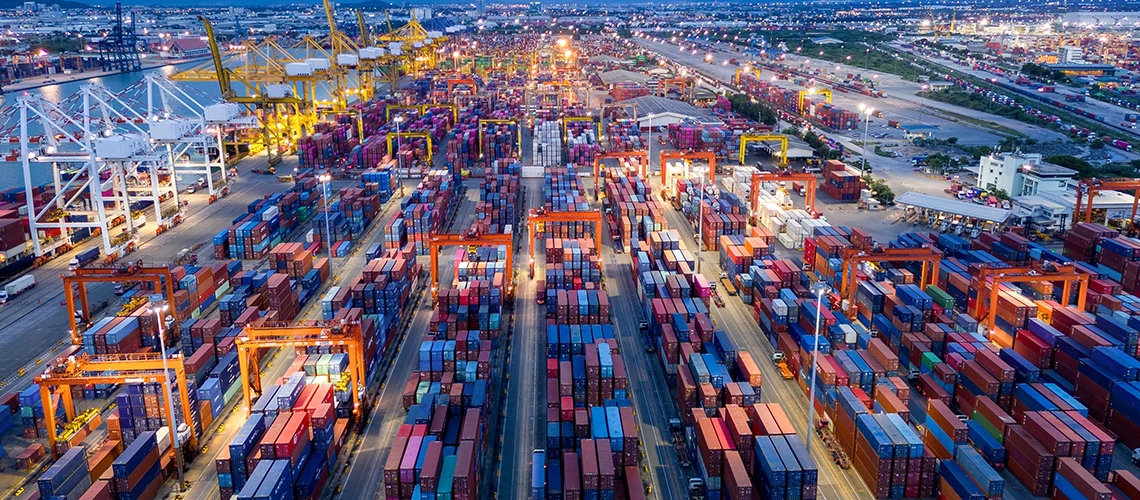
 The evidence points to a global trade landscape that is changing, but not necessarily becoming weaker. | © Shutterstock.com
Global trade is being reshaped by both powerful shocks and deep structural shifts. At the same time, new sources of dynamism are emerging, especially in trade related to artificial intelligence (AI).
Trade in the 2020s has been buffeted virtually every year—by the pandemic, supply-chain disruptions, rising trade tensions, geopolitical conflicts, and heightened policy uncertainty. At the same time, longer-term forces are altering the pattern of global trade. One is the maturation of global value chains: many of the biggest gains from spreading production across countries have already been realized. Meanwhile, emerging-market and developing economies (EMDEs) are now twice as important to the growth of global trade as they were in the 1990s—partly because of a proliferation of regional trade agreements. Together, these forces have made global trade more fragile in some respects, but also more adaptable in others. This blog addresses five topical questions on the near- and long-term factors affecting global trade.
1: How has global trade growth evolved over time?
Global trade growth has halved, falling from about 6 percent in the 1990s to just under 3 percent in the 2020s, making the current decade the slowest in four decades. The 1990s and early 2000s saw rapid expansion, fueled by trade liberalization, the integration of large emerging economies, and the swift growth of global value chains. Since then, momentum has faded, with growth easing to roughly 5 percent in the 2010s and weakening further in the 2020s (figure 1A). This structural slowdown reflects weaker investment growth, the maturation of global value chains, elevated trade tensions, and successive global shocks, including the deepest global recession in decades during the pandemic, which weighed heavily on trade.
The slowdown in global trade has been concentrated in goods. Services trade has followed a different trajectory. Between 2005 and 2023, the value of services trade more than tripled, supported by technological advances and the expansion of trade in intermediate services, where barriers are relatively lower. This divergence highlights a shift in the composition of global trade, with services now accounting for roughly one-quarter of total trade, up from about one-fifth in the early 2000s.
Figure 1. Global trade growth
2: What’s the near-term outlook for global trade?
Near-term prospects are uncertain. Trade growth remained remarkably resilient at 3.4 percent in both 2024 and 2025. The resilience last year partly reflected the front-loading of shipments ahead of tariff increases and firms adapting to new trade policies (figure 1B). Recent data suggest that trade growth in 2025 is likely to have exceeded earlier estimates. Additional support came from bilateral agreements, limited retaliation, greater use of existing trade preferences, and trade linked to buoyant investment in AI.
Looking ahead, forecasts from a range of institutions place global trade growth between 1.7 percent and 3.1 percent this year, highlighting considerable uncertainty around the near-term outlook. Prior to the conflict in the Middle East, forecasts had been tilting upward following tariff reductions, new trade agreements, and unilateral measures such as the U.S. reauthorization of the African Growth and Opportunity Act and China’s zero-tariff treatment for 53 African countries. The conflict weighs on global trade by disrupting shipping routes, raising transport costs, and spreading supply risks from energy into fertilizers and other key inputs.
3: Why has global trade remained resilient?
In response to uncertainty, many countries have pursued trade liberalization to diversify export markets and deepen ties with new partners. Early evidence suggests diversification paid off in 2025. Countries with more diversified export destinations experienced stronger export demand than those relying on a narrower set of markets. In the last quarter of 2025, nearly 30 percent of countries with more diversified exports recorded manufacturing export order Purchasing Managers’ Index (PMI) readings above 50—signaling expanding rather than contracting orders—compared with just 18 percent of countries with a more concentrated export base (figure 2A).
Stronger trade within regional trade agreements (RTAs) has also underpinned the recent resilience. The share of global trade taking place among members of these agreements rose from about 40 percent in 1990 to over 60 percent by 2025 (figure 2B). This shift reflects the growing number of RTAs as well as their expanding role in shaping global trade networks. Regional trade agreements have helped stabilize trade relationships, reduce policy uncertainty, and promote diversification by lowering barriers among members. Although the European Union and the three signatories to the United States-Mexico-Canada Agreement (USMCA) remain the largest blocs, agreements involving EMDEs, including the African Continental Free Trade Area, have become increasingly important and accounted for about 37 percent of global trade in 2025.
Figure 2. Role of trade agreements
4: Why are EMDEs now so important to global trade?
EMDEs have become a major engine of global trade growth. In the 1990s, they accounted for about 22 percent of global trade growth, but their contribution has since risen to slightly more than half of global trade growth (figure 3A). This shift reflects deeper integration into global supply chains, rapid industrialization, and stronger domestic demand. It has also been supported by reductions in trade costs, including those associated with World Trade Organization accession commitments.
Several EMDE regions have emerged as key contributors (figure 3B). The East Asia and Pacific region has played the largest role, with its contribution rising from 12 percent in the 1990s to 26 percent in the 2020s, underscoring its central position in global manufacturing and regional value chains. South Asia and the Middle East and North Africa have also gained importance in driving global trade, with their contributions increasing to around 7 percent each in the 2020s. The share of Europe and Central Asia surged in the 2000s but has moderated since, while the contribution of Latin America and the Caribbean has remained broadly stable. Sub-Saharan Africa continues to account for a relatively small share of global trade.
Figure 3. Contributions of country groups and regions
5: How is AI affecting global trade?
AI is already reshaping global trade, well before the technology’s broader productivity effects materialize. Rapid investment in AI infrastructure, including advanced chips, data centers, and specialized computing equipment, has driven a surge in demand for AI-related goods. Although these products span only a small number of tariff lines, their share in global goods trade rose to over 5 percent by end 2025, from less than 3.5 percent in 2023–24 (figure 4A). In the United States, the share of AI-related equipment in imports more than doubled, exceeding 12 percent in October 2025.
Figure 4. AI and global trade
AI-related trade also provided an important boost to overall goods trade in 2025, helping offset the effects of higher tariffs and rising policy uncertainty. In nominal terms, AI-related trade grew by an average of 34 percent year-on-year each month in 2025, far outpacing the 6.5 percent growth recorded for other traded products (figure 4B). Growth peaked at 47 percent in July 2025 and remained strong later in the year, highlighting the rapid expansion of AI driven trade.
Conclusion
Taken together, the evidence points to a global trade landscape that is changing, but not necessarily becoming weaker. Even as trade growth has slowed, diversification, regional integration, the rising role of EMDEs, and AI-related demand are reshaping trade patterns and reinforcing resilience. Amid unprecedented increases in tariffs, many countries have continued to deepen trade linkages. The key question now is whether policy choices going forward will support this adaptation and help sustain a more resilient and dynamic trading system.



Join the Conversation