
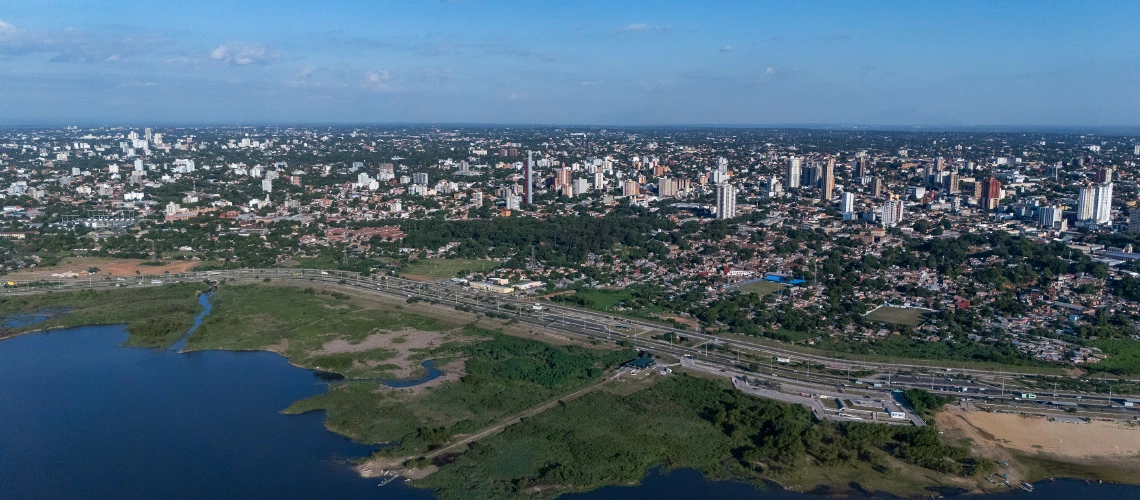
 Aerial view of Asunción, Paraguay.
In the last 20 years, poverty in Paraguay has plummeted from over 50 percent to only 16 percent in 2025. In just two decades, a third of the population has escaped poverty, with another 300,000 rising out of poverty just in the last two years.
Progress at this pace, scale, and duration does not happen by accident. Paraguay’s success is what happens when governments focus on productivity and jobs. Paraguay’s GDP growth has been nearly 5 percent per annum, among the fastest in Latin America. But for progress in poverty and shared prosperity, what drives growth matters. Labor income growth was the primary driver of poverty reduction in 2025, with the largest gains concentrated at the bottom of the income scale. Employment has grown and shifted toward more stable, better-compensated work. Sustained growth in employment and labor incomes is only possible with growth in the productivity of labor. Economic growth improves people’s lives when there is a focus on including people in an increasingly productive economy through job creation.
Paraguay’s progress has focused on the foundations of job creation: infrastructure that lowers costs, increases productivity, and allows people to connect to the increasing creation of economic value; a regulatory framework that allows businesses to invest and encourages job creation; and programs that strengthen the capabilities of workers.
Infrastructure that expands access to power and connects economic activity is essential. Reliable energy is critical to a job-enabling environment. Abundant and clean hydropower from the Itaipú and Yacyretá dams gives Paraguayan industry an enduring cost advantage, attracting investment in manufacturing and green industries. Integrating firms and people into increasingly sophisticated and productive value chains requires the low-cost connections within Paraguay, across the region, and to global markets. Low-cost transmission of goods and information via roads, riverine ports, and digital connectivity are critical.
Paraguay has also strengthened the regulatory framework for doing business and hiring workers. A new law automated registration for small and medium enterprises and introduced flexible labor contracts, cutting the cost of formality. A modernized maquila regime extended manufacturing incentives to twenty years and opened the model to services, broadening the base for job creation. These business-enabling reforms reduce risk, create certainty, and make it easier for the private sector to invest, expand, and hire.
Expanding productive physical capital through private investment creates the conditions for increased labor productivity. A new Investment Law, an updated framework for public-private partnerships, and a modernized capital markets regime have been key. Together, these reforms helped Paraguay earn two investment-grade credit ratings in just eighteen months—the only country in Latin America to do so this decade. Sound fiscal management, anchored by Paraguay’s Fiscal Responsibility Law, has created space for private investment to grow. Macroeconomic stability matters. Investors think about years, not months.
Social programs have reinforced the expansion of human capabilities. Hambre Cero—Zero Hunger—now feeds over one million children across Paraguay’s public school system. In rural areas, where poverty runs deepest, it has made a measurable difference to children’s opportunity to thrive. Its design links nutrition directly to local economic development: it sources food from family farmers and small businesses in the same communities. Paraguay is not relying on anecdotes: a real-time administrative system tracks every component of the program, from meals planned to meals served. That focus on results—not just spending—is what makes programs work.
There remain gaps and lagging regions. Departments like Caaguazú, Caazapá, and San Pedro still record poverty rates well above the national average. Addressing these gaps requires the same approach of focusing on the inclusion of lagging regions into the dynamism of expanding productivity. Paraguay and the World Bank recently produced the country’s first poverty map in more than two decades, covering all 263 districts. That map is now guiding where investments go and how programs like Hambre Cero are targeted. Better data leads to better policy. Better policy leads to better results.
Paraguay’s experience is worth studying. Sustained poverty reduction through rising labor incomes and job creation does not follow any single policy. It is built up from the foundations: infrastructure, a business-friendly regulatory environment, and support to the private sector to scale, underpinned by strong macroeconomic policies and investments that ensure everyone can start life healthy and able to learn. That combination is what made the difference here, and it is replicable.


Join the Conversation