
 Aerial view of the historic old town of Khiva, Uzbekistan. Photo: Yoshie/Adobe Stock.
Governments rarely fail because of a lack of effort. They fail because effort disperses.
Ministries pursue their sector plans. Teams deliver their projects. Units track their own indicators. Everyone is busy. Reports are produced, dashboards updated, budgets spent. And yet, at the end of a planning cycle, the results that were supposed to change people's lives — better schools, cleaner water, more jobs — often fall short of what was promised.
This is the central challenge of public delivery: not capacity, not intent, but coherence. Getting a government — or any large institution — to move together toward a shared result is harder than it looks. And understanding why the first step is to fix it.
The problem: systems that spin without steering
When a government organizes itself around inputs — money spent, activities completed, and outputs delivered — it creates a powerful illusion of progress. Things are happening. There is motion everywhere.
But motion is not the same as direction.
In an input-oriented system, each unit moves according to its own logic. Information is abundant but arrives too late, too aggregated, or too detached from decisions to actually change what happens next. Adjustment becomes episodic — challenges are explained after the fact, course corrections follow reporting cycles rather than operational needs, and learning is retrospective. Valuable, but often too late to matter.
Under pressure — fiscal, political, social — this kind of system does not align. It simply spins faster.
This is not a failure of will. It is the natural result of a system that has no shared center of gravity.
Uzbekistan: building a center that holds
When Uzbekistan began reforming its strategic planning system, this was precisely the challenge on the table.
The government was not short of strategies. Plans, indicators, and reporting structures existed across ministries. What was missing was a unifying mechanism — a way to ensure that all this effort converged on outcomes that truly mattered to people.
The initial response was to establish a Delivery Unit within the Agency for Strategic Development and Reforms under the President, focused on a small number of priority areas: public health, education infrastructure, and access to drinking water. The model was deliberately designed to be data-driven and citizen-centric, with a strong emphasis on problem-solving and a clearly defined mandate.
This marked the beginning of a deeper shift. Strategy was no longer treated as a statement of intent, but as a commitment to measurable results.
That reframing changed everything downstream. Delivery conversations moved away from tracking activities toward defining what success looked like in concrete terms. The purpose was not to explain performance after the fact, but to steer it while it was still unfolding.
Over time, these efforts laid a strong foundation for scaling reforms under the Uzbekistan–2030 strategy — the nation’s overarching vision for long-term development.
Guided by consistent stewardship from the President’s Administration, what began as a targeted delivery approach evolved into a broader, system-wide model — enabling alignment across sectoral policies, streamlining monitoring, and integrating processes into a unified digital platform with geoportal capabilities and continuous citizen feedback loops.
The objective was not to increase oversight, but to build a system that knows when to act. Signals should trigger decisions, not accumulate into reports. Deviations should prompt correction, not explanation. And meetings should not end with summaries, but with changes in course.
That rhythm — continuous, real-time, and action-oriented — is what effective delivery looks like in practice.
The physics of it: a concept worth borrowing
There is a useful way to describe what Uzbekistan built, borrowed from physics.
A centrifugal system (one that pushes actors away from each other) means everyone orbits their own logic. A centripetal system (one that pulls actors toward a common center) orients everyone around a shared outcome. The actors, the constraints, the complexity: none of that disappears. But the force changes direction.
The two systems look like this:
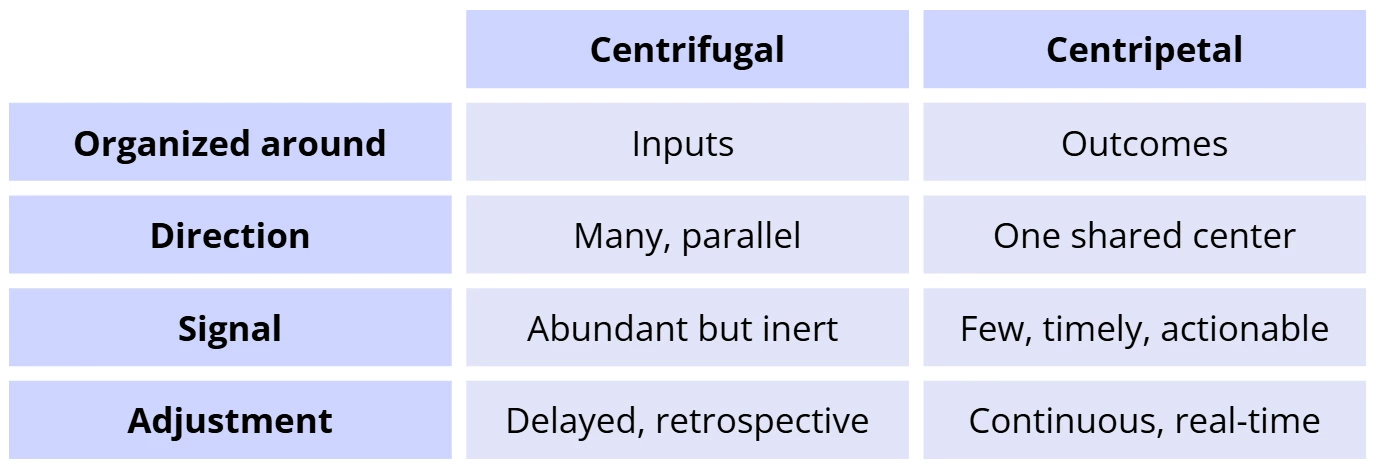
What makes this framework useful is not its elegance — it is the clarity it offers about what needs to change. Shifting a system is not about adding more. It is about removing what weakens the center and reinforcing what creates pull.
Three moves that create pull
Whether in a national government or a large institution, the shift toward delivery-focused coherence typically involves three recognizable moves.
The first is to fix the center. This means choosing one outcome that cannot be negotiated and making it the reference point for all decisions. When everything is a priority, nothing pulls. When the center is vague, effort disperses. A system begins to come together the moment the center becomes clear and non-negotiable. In Uzbekistan, this meant anchoring the entire planning system to results that are visible, measurable, and owned at the highest level.
The second is to elevate the signal. This requires narrowing attention to the few indicators that actually matter — those that arrive in time and demand action. If a signal does not change a decision, it is noise. If it arrives late, it is history. If no one owns it, it is decoration. The strength of a system lies not in how much it measures, but in how precisely it knows when to act.
The third is to force the turn. Adjustment must become immediate, visible, and expected. This is perhaps the hardest move, because it requires changing the rhythm of how institutions work — from episodic reporting to continuous steering, from retrospective explanation to anticipatory correction.
What this means at scale
The World Bank Group has been grappling with the same challenge. Moving from 152 results indicators in our Scorecard to 22 that connect strategy, operations, and accountability is an attempt to fix the center at an institutional level. Tools like the WBG Targets are designed to do the same thing Uzbekistan's stocktakes do: reduce noise, elevate signal, and bring evidence into the moment of decision rather than the moment of review.
The parallel is instructive because the underlying problem is not unique to any one government or institution. Any system large enough to require coordination is susceptible to centrifugal drift. The antidote is always the same: a clear outcome, a disciplined signal, and the organizational will to act on what the signal says.
Artificial intelligence will intensify this dynamic. It can flood systems with more data, deepening drift — or it can sharpen signals, strengthening pull. Technology itself does not determine the outcome. The system does.
The simplest way to see it
In one system, everyone is busy doing their part. In the other, everyone is moving toward the same result.
That distinction — not effort, not intelligence, not even resources — is what separates governments that deliver from governments that drift.
Uzbekistan's experience shows it is possible to build a system that turns toward results rather than spinning away from them. The physics are demanding. But the moves are learnable.


Join the Conversation