
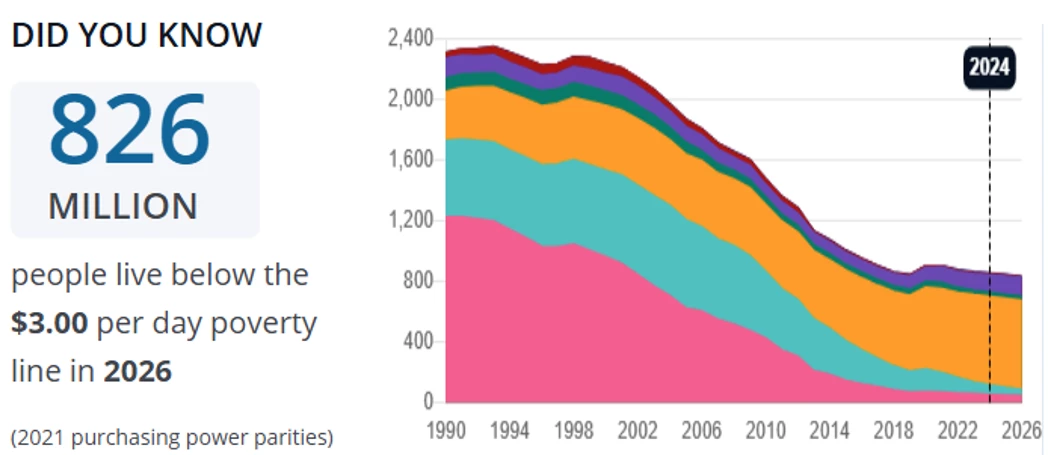
Global poverty estimates up to 2024 were updated today on the Poverty and Inequality Platform (PIP), including nowcasted estimates up to 2026. The share of the global population living in extreme poverty in 2024 is revised upwards slightly from 10.3 percent to 10.4 percent.
The update involves three changes to the PIP data (see the What’s New document for more details): First, the update brings new survey data for a total of 28 country-years, including new data for Pakistan, which ensures regional coverage for the Middle East, North Africa, Afghanistan and Pakistan region in recent years; second, existing data is improved for several country-years; and third, it incorporates an updated approach to improve the precision of data used from the Luxembourg Income Study Database for several advanced economies.
As of 2024, 847 million people are estimated to live in extreme poverty. This is a slight upward revision of approximately 8 million people compared to the September 2025 data vintage (see Table 2 in the What’s New document).
The upward revision stems primarily from an increase in the extreme poverty rate of the MENAAP region. The update includes a new survey dataset from Pakistan, which results in an upward revision in the extreme poverty rate of the region in 2024 from 11.8 percent in the September 2025 data vintage to 14.4 percent in the March 2026 vintage (see table below). The increase results in an additional 21 million people living in extreme poverty in the region. The Middle East, North Africa, Afghanistan and Pakistan region is the only region, where the extreme poverty rate has increased in recent years.
Globally, the nowcasted estimates project a decrease in extreme poverty from 10.4 percent in the current line-up year of 2024 to 10.0 percent in 2026. The nowcasts are based on projections of national accounts data from the January 2026 Global Economic Prospects, which are the latest data available at the time of the update. They thus do not reflect more recent events.
As a result of the new surveys included in the PIP update, coverage is ensured across all regions in recent years, except for the sub-region of Eastern and Southern Africa, which is covered until 2023.
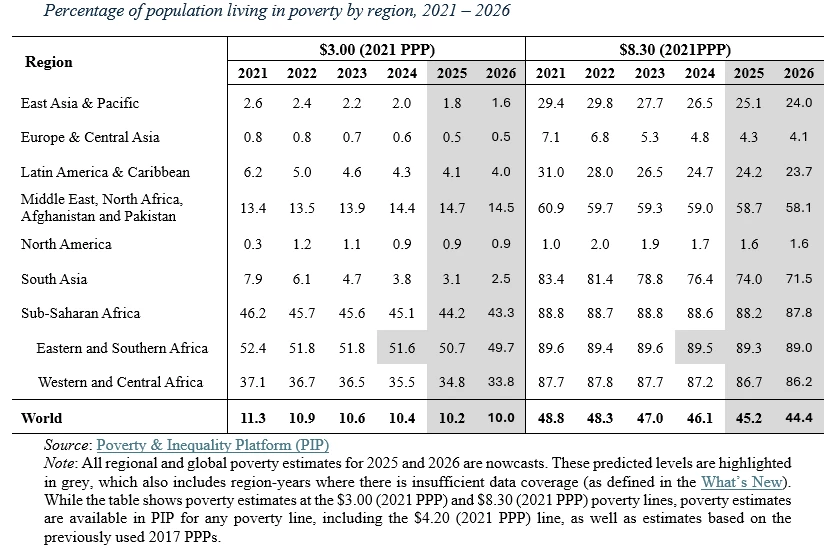
Developments in the extreme poverty rate continue to diverge across regions. All but two regions have extreme poverty rates below 5 percent. In addition to the increasing poverty rate of the Middle East, North Africa, Afghanistan and Pakistan region, poverty rates remain stubbornly high in Sub-Saharan Africa. In fact, Sub-Saharan Africa is estimated to bring the extreme poverty rate back to pre-Covid levels only in 2025 (see figure 1 below). Both regions are currently very far from eradicating extreme poverty.
Figure 1: Global and regional poverty trends, 1990 – 2026
The 2026 nowcasts in this blog have been revised slightly to correct an error on the PIP website. This affects the regional and global aggregates in 2026. All other estimates are unaffected. Further details on the changes are available on the PIP website.
Would you like to be updated with the latest news on PIP? Register to our newsletter here.
The authors gratefully acknowledge financial support from the UK Government through the Data and Evidence for Tackling Extreme Poverty (DEEP) Research Program.






Join the Conversation