
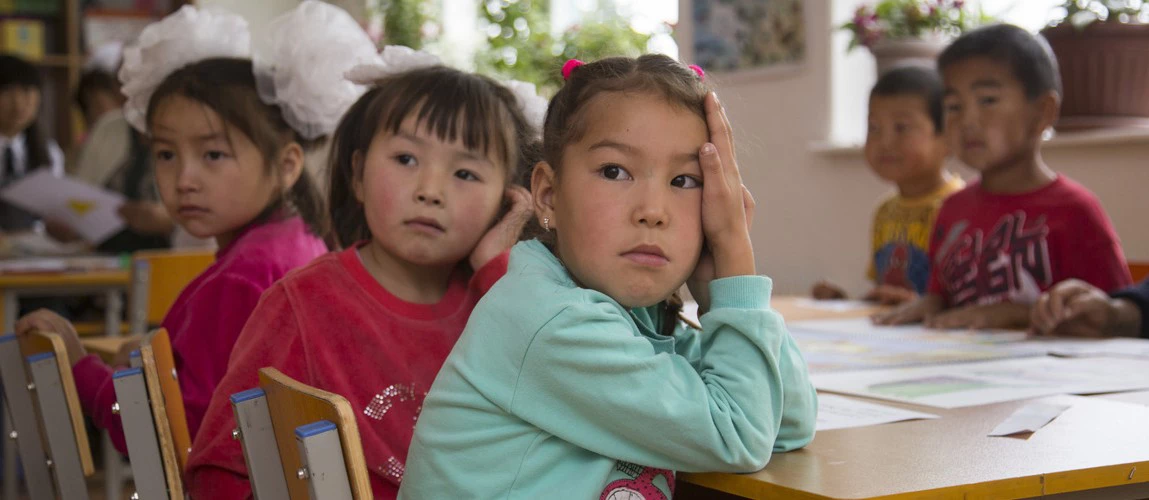
 Children attending a rural preschool in Issyk Kul Region, Kyrgyz Republic. Copyright: Kubat Sydykov/World Bank
In 2024, 53% of working-age women in the Kyrgyz Republic were in the workforce, which means nearly half weren’t working or even looking for a job. While the female labor force participation rate in the Kyrgyz Republic is higher than that of Uzbekistan (39%), it lags behind many other countries in the region, where Moldova leads with 70%, followed by Kazakhstan (66%) and Azerbaijan (60%). More striking still is the difference in labor force participation between men and women, which stands at 26 percentage points, according to recent data from the WDI and ILO—one of the largest in the region.
At the World Bank Group, our goal is to help countries build economies that convert growth into local jobs. We hypothesized that access to childcare was a critical barrier for women seeking jobs in the Kyrgyz Republic. But we needed concrete evidence backed by data, which could also give us insights into what can be done.
The latest household survey data from the Kyrgyz Republic suggests that when women have access to childcare, they are more likely to work. Here are the main findings from our research:
- Having young children keeps mothers out of work, especially when children are under 3 years old. Mothers with a child aged 0–2 are about 5 percentage points less likely to be employed.
- Preschool more than compensates. For children aged 3–6, preschool is linked to a 3.8 percentage point boost in mothers' employment.
- Childcare doesn't just allow mothers to enter the labor market — it lets women work on fuller terms. Employed mothers with a 2-year-old in preschool work about three extra hours per week, an 11% increase over the average of 26 hours.
The data point to a clear conclusion: Expanding preschool access could be one of the most powerful ways to remove barriers that prevent women from entering the workforce. Indonesia's experience points in the same direction. According to World Bank research, an additional public preschool per 1,000 children increased the work participation of eligible mothers by 9.1%. Yet it also showed that design matters: Preschools running only three hours a day tended to push women into unpaid family work rather than paid employment, underscoring why the duration and structure of childcare is just as important as its availability.
The good news is that the Kyrgyz government has already taken meaningful steps in this direction. Even before the recent wave of reforms, preschool enrollment for children aged 3–6 had been climbing, from 27.9% in 2015 to 38.5% in 2021. However, well over half of young children were still outside the system. The government has since replaced a cumbersome licensing process, which previously required more than 15 separate permits, with a streamlined online registration system. It also introduced vouchers to help lower the cost burden on families. And in 2024, it launched the "Altyn Kazyk" (Polar Star) education transformation initiative, which aims to expand preschool coverage and develop public-private partnership models for early childhood education infrastructure.
The World Bank Group supports these efforts through the Learning for the Future Project, which has helped set up nearly 500 community-based kindergartens in rural and low-income areas. A new phase running through 2028 is piloting full-day childcare and public-private partnerships to reach more families. The National Community Initiatives Project takes this further by treating childcare not only as a social service, but as an economic opportunity. Alongside investing in public kindergartens in underserved communities, this project is piloting private childcare facilities in rural areas—providing grants to support their establishment and offering targeted training for women entrepreneurs who want to open and run childcare businesses. Expanding the supply of private childcare provides double the benefits: It increases access for families while creating jobs and income opportunities for women.
Taken together, these efforts are not just expanding access to childcare. They are helping mothers pursue their careers while knowing their children are safe and learning—helping them fully participate in the economy and secure the jobs their families depend on.

Join the Conversation