
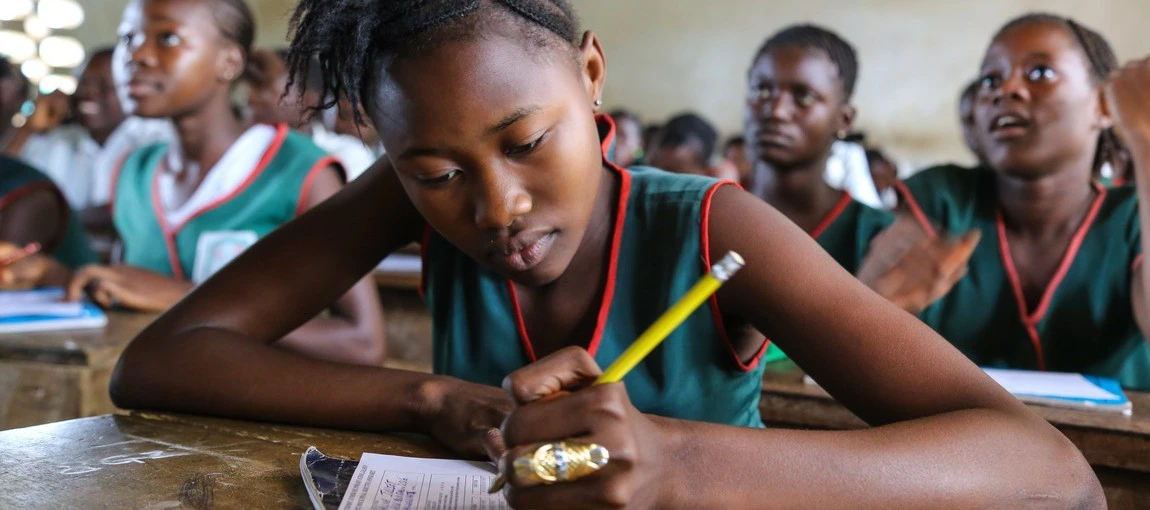
 Sierra Leone's human capital strategy aims to build a workforce that is skilled, adaptable, healthy and productively employed, capable of driving the country’s broader national development and industrialization goals. Copyright: George Lewis/World Bank
In February 2026, I joined global leaders and practitioners at the World Bank to reflect on a question that is both timely and central to Sierra Leone’s reform agenda: How do we move from ambitious human capital strategies to measurable improvements in people’s lives?
The conversation was anchored in the launch of Building Human Capital Where It Matters: Homes, Neighborhoods, and Workplaces, a report that rightly refocuses attention on the real-world settings where human capital is formed. For me, this is not an abstract policy debate. It sits at the heart of our work at the Ministry of Technical and Higher Education and reflects my own journey from multidisciplinary researcher to policymaker. Research teaches us to interrogate systems using context-specific evidence; governance requires us to fix them.
Human capital beyond the classroom
One of the most important insights from the report is that human capital is built not only in learning institutions but also in homes, communities, and workplaces. For too long, education policy globally has operated in silos. Yet the evidence is clear: A child who is malnourished will struggle to learn; a student without access to electricity cannot fully engage with digital learning and risks falling behind in 21st-century competencies; and a graduate without access to a dynamic labor market cannot translate skills into productivity or lifelong learning.
Human capital is the true engine of long-term prosperity, and it grows strongest when investments in people are connected across the full ecosystem of home, community, and work. As a systems challenge, it requires linking early childhood development, foundational learning, life skills, technical training, labor markets, and industrial growth into one coherent pipeline.
Sierra Leone’s reform response
In Sierra Leone, the technical and higher education sector is gradually shifting from a traditional focus on credentials to a stronger emphasis on skills that enhance productivity and employability. We are strengthening demand-driven technical and vocational education and training (TVET) aligned with priority sectors such as agricultural value chains, renewable energy, construction, hospitality and the digital economy. This approach emphasizes private sector engagement in curriculum development, certification, and program accreditation in collaboration with our regulatory agency, the National Council for Technical and Vocational Education (NCTVE), guided by the revised NCTVE Act of 2025. The legislation underpins our commitment to transforming TVET by prioritizing employment-relevant skills, recognition of prior learning, and alignment with international best practice.
Advancing inclusion and gender equity
Inclusion remains central to our human capital strategy. Equitable access to education and skills training, particularly for women, is being expanded through targeted financing reforms, including revisions to the national Grant-in-Aid policy to increase female participation in science, technology, engineering, agriculture, and mathematics. The policy is a government-funded social intervention program designed to provide financial support to qualified female Sierra Leonean students and students with special abilities (amongst other designated beneficiaries) in tertiary and vocational institutions.
These efforts are anchored in Sierra Leone’s Gender Equality and Women’s Empowerment Act and are designed to empower women to compete for leadership roles in historically male-dominated sectors. In addition, deliberate recruitment efforts are underway to increase female participation in technical fields such as automotive training, through the Government of Japan and Government of Sierra Leone-funded Centre of Excellence for Automotive Training.
Beyond the formal sector, with support from the African Development Bank, we are equipping women and youth in the informal economy with soft skills, digital literacy, and financial management capabilities to strengthen small businesses in agriculture and waste management.
Strengthening systems and data for delivery
We are also deepening structured collaboration across government. Human capital outcomes sit at the intersection of education, health, finance, energy, gender, youth, and labor, and no single ministry can deliver the full pipeline alone. With support from the World Bank, the development of the Country Partnership Framework is reinforcing this intra-government approach and ensuring that investments are aligned around shared national human capital priorities.
Data will be central to the next phase. Our integrated education management information system will link to a national quality dashboard with indicators aligned to key national and global benchmarks, including the Medium-Term National Development Plan, Sustainable Development Goal 4, the Human Capital Index, and regional frameworks such as ECOWAS, and the African Union’s Agenda 2063. The expanded Human Capital Index (HCI+) will serve as an external benchmark, enabling Sierra Leone to track performance across the lifecycle, compare progress with peer countries and target interventions more effectively. At the ministerial level, this means moving beyond parallel mandates toward structured collaboration, disciplined implementation platforms and continuous learning loops that allow policy to adapt based on real-time evidence.
Industry as co-designer
If human capital is built partly in workplaces, then the private sector must be at the table as co-investor and co-designer. We must build capacity with industry, for industry, and not for industry alone. Engagement with employers is therefore being intensified to strengthen apprenticeships, improve curriculum relevance, expand entrepreneurship pathways, support lifelong learning and promote the development of 21st-century skills such as digital fluency, problem-solving and adaptability. At the same time, the global shift toward climate resilience requires accelerated investment in green skills, particularly in renewable energy, sustainable construction, climate-smart agriculture and circular economy models that are central to Sierra Leone’s long-term industrialization pathway.
Looking ahead
If there is one message I carried from the World Bank dialogue, it is that human capital investments pay off only when ecosystems function. For Sierra Leone, the next phase of our agenda will emphasize stronger learning institution-to-work transitions, deeper industry partnerships, expanded lifelong learning pathways, more intentional support for women’s economic participation and integrated, data-driven decision-making across government. Our ambition is not simply to produce more graduates. It is to build a workforce that is skilled, adaptable, healthy and productively employed, capable of driving the country’s broader national development and industrialization goals.
The global conversation on human capital is evolving in the right direction, but the real test lies ahead: translating insight into implementation at country level. That is the work before us, and it is work we are committed to advancing with urgency, evidence, and partnership. Our task is to connect systems, scale evidence, and deliver results where human capital is actually built—in homes, communities, and workplaces. Sierra Leone is moving forward with discipline and determination.
Join the Conversation