
 Cityscape of Addis Ababa Ethiopia by Benedek, Canva
Even when policies are well-designed, governments in both developing and developed countries frequently struggle with effective implementation, resulting in less than optimal economic outcomes (Dincecco 2017, Evans and Rauch 1999, Acemoglu et al. 2005, Besley and Persson 2009, Dincecco and Katz 2016). Unsurprisingly, there are widespread calls to strengthen state capacity for implementation: doing so effectively requires an evidence-based approach (Andrews, Pritchett, and Woolcock 2017).
Why do some institutions succeed at implementing policies while others fail? Measuring state capacity, a crucial factor in developmental impact, has often been a challenge (Hendrix 2010). Few systematic approaches exist. Our new paper, Institutional Capacity for Policy Implementation: An Analytical Framework, offers a public-sector framework that makes state capacity comprehensive, simple, and measurable. We shift the focus from governments as a whole to institutional capacity—the ability of public institutions to implement their specific policy mandates.
From state capacity to institutional capacity
Traditionally, “state capacity” is used as a catch-all term to describe a government’s (in)ability to implement policy (Mann 1984). This broad concept is often insufficient to diagnose or address specific implementation challenges. Actionable reform requires zooming in on the actual public institutions — ministries, departments, agencies, and state-owned enterprises—that implement policies in the public sector. Building on recent research, the paper recognizes that institutional capacity varies both across and within countries. Some institutions are “pockets of efficiency” in challenging environments, while others struggle to achieve their objectives (Bersch, Praça and Taylor 2017, McDonnell 2017). For example, data from the Global Survey of Public Servants show that interview-based recruitment in Brazil’s public institutions ranges from 0 to 30 percent (See figure 1), while Ethiopian institutions vary widely from none to almost full reliance on interviews.
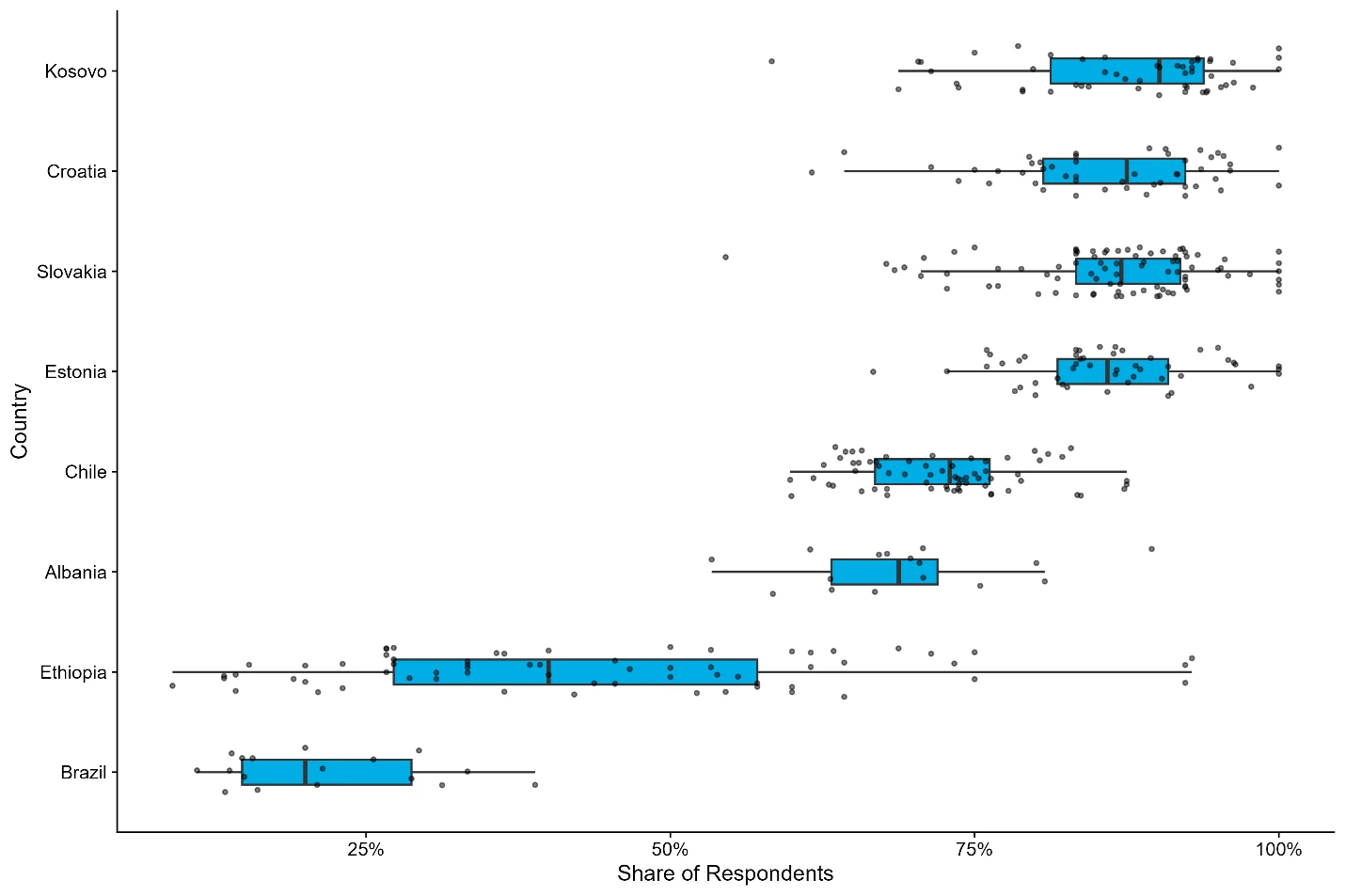
Source: Global Survey of Public Servants. Each black dot represents an institutional-level share. Survey data collected between 2016-2019, but date of collection varies by country.
The analytical framework: Two cross-cutting dimensions
The framework categorizes the factors that shape institutional capacity into organizational and governance dimensions, each measurable at the public institution level:
1. Organizational Dimensions: For a public institution to fulfil its mandate, all organizational components must work well to ensure that the institution can deliver its mandate.
- Personnel: The recruitment, skills, compensation, and training of staff – from high-level appointees to frontline workers – affects the performance of public sector employees.
- Financial Resources: Delays and inefficiencies in budget allocations can undermine even well-funded programs.
- Information Systems: Data collection, data-sharing processes, and digital systems can improve efficiency and transparency, when actively used and integrated.
- Management Practices: High-level strategies, institutional coordination, and the articulation of a strategic vision can shape the direction of an institution.
Figure 2. Accountability of regulators varies across sectors
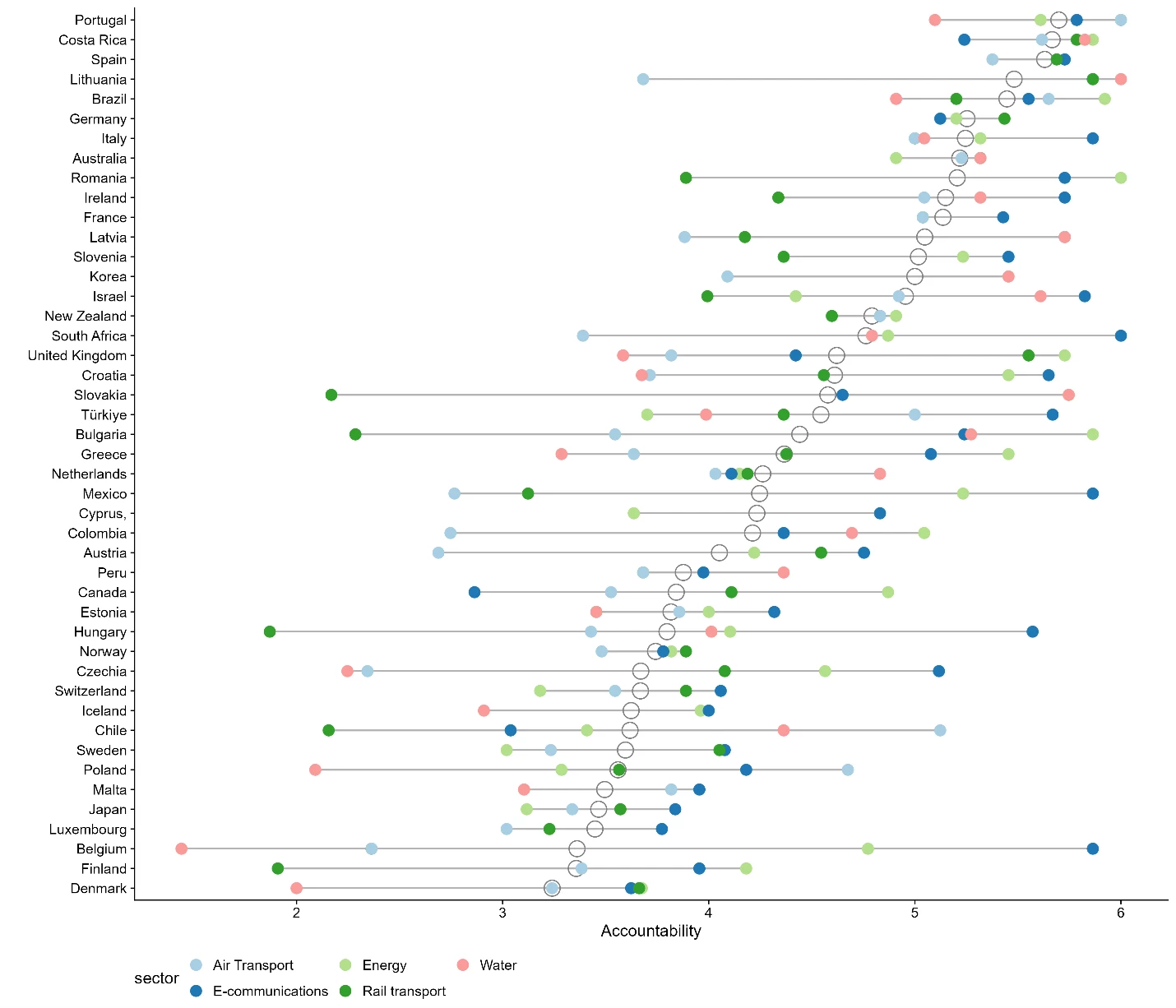
Source: Authors’ elaboration based on data from the Governance of Sector Regulators, 2025. Scores vary from 0 (lowest accountability) to 6 (highest accountability). Each color corresponds to a different sector regulator. Data is self-reported and reviewed by the OECD. Not all sector regulators have responded to the questionnaire for each country.
2. Governance Dimensions: These components affect both the institution’s ability to deliver, and whether it will do so in the public interest.
- Accountability: External stakeholders such as citizens, other institutions, or civil society can hold regulators accountable for poor performance, which encourages better outcomes. Figure 2, drawing on OECD Governance of Sector Regulators data, shows that accountability levels vary across sector regulators within a single country.
- Independence: Protection from undue private or political influence ensures that institutions act in public interest.
- Transparency: Making decisions and actions visible to the public promotes accountability and reduces opportunities for corruption.
Governance dimensions are cross-cutting, meaning that they can be applied to each organizational dimension. One can analyze personnel independence, financial transparency, and information system accountability—for instance, allowing external stakeholders to audit data records and enact consequences if records are manipulated.
Using the framework to diagnose implementation problems
The framework is designed to help policymakers and practitioners diagnose why policies fail. For example, if a regulatory agency struggles to enforce consumer protection, the root cause might be poor recruitment practices, lack of specialized departments, or weak accountability mechanisms. Common implementation problems can thus be linked to specific organizational or governance dimensions. Consider the common problem that public officials fail to meet performance standards, such as teachers and doctors showing up late to work or mid-level staff skipping monitoring visits. This can result from weak links between performance and career advancement, unclear responsibilities that encourage free-riding, poor management practices, and ineffective use of information systems for monitoring. Specific governance issues can stem from officials motivated by private interests, lack of independence, weak accountability mechanisms, and limited transparency. These factors may simply be the tip of the iceberg, but the framework helps categorize and analyze their roots.
Institutional capacity is actionable and measurable
This framework translates state capacity into measurable, actionable components, empowering governments, researchers, and development partners to design more targeted reforms. It also highlights the importance of collecting better institution-level data rather than relying on national averages, that can mask critical differences across institutions.




Join the Conversation