 Image credits: Shutterstock
When it comes to public financial modernization, many reforms hit a familiar roadblock: technology outpaces institutions. Digital tools can automate processes, but without strong institutional capacity, governments struggle to manage revenue, risk, and accountability. Our experience over the past three decades has shown that simply digitizing systems—without proper coordination across governance, data architecture, and operational planning—leaves inefficiencies unresolved.
As economies shift to digital platforms, tax agencies face an increase in transaction volumes, stricter reporting deadlines, and rising cybersecurity threats. Systems designed for manual or fragmented workflows can’t keep up, exposing a growing gap between what technology can do and what organizations are prepared to handle.
Georgia provides a compelling case study of how governments can tackle this challenge. With strong economic growth—7.8% in 2023 and 9.4% in 2024—and increased fiscal flows, administrative complexity has soared. Meanwhile, demand for digital solutions across financial institutions is growing quickly. To maintain performance in these conditions, platforms must securely manage large datasets while supporting real-time analytics for compliance and policy decisions.
Institutional Constraints and Reform Response
Modernizing the Georgia Revenue Service (GRS) is at the heart of the country’s Vision 2030 Development Strategy and EU aspirations. Previous digital initiatives have focused on automating individual processes and developing operational modules, but lacked a cohesive, future-proof integration vision. As a result, this limited interoperability and made it difficult to use data strategically across all functions. This affected everything from cybersecurity compliance and taxpayer data protection to risk-based oversight, predictive analytics, and comprehensive taxpayer profiling. As transaction volumes increase and data exchanges grow, these challenges pose systemic risks rather than mere technical issues.
To address these issues, the World Bank provided technical assistance, helping Georgia develop a structured modernization roadmap. This plan, aligned with the GRS Strategy 2025–2030, sets four institutional goals supported by twenty-two objectives, each with performance targets emphasizing digital advancement. These goals include improving taxpayer services through digital channels; strengthening ICT infrastructure and analytics; aligning operations with international standards; and modernizing organizational processes and workforce capability.
The aim was not only to digitize processes, but on ensuring technology investments matched institutional strategies and delivered measurable outcomes.
From Strategy to Execution
To turn strategy into action, we mapped ninety-two operational activities directly to strategic objectives, creating a traceable link between policy intentions and daily tasks.
Unlike traditional indicators focusing only on final outcomes, we introduced Progress Performance Indicators (PPIs) to monitor implementation of milestones. Each activity on the road map is linked to a measurable indicator tied to a strategic goal, enabling managers to track progress, spot delays early, and adjust actions proactively. This system embeds accountability into routine management instead of relying solely on periodic evaluations.
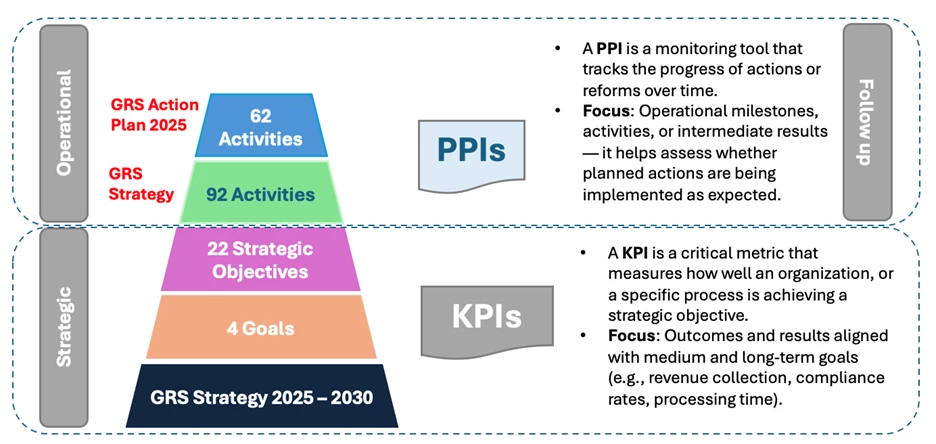
The key institutional progress was creating a formal link between the annual operating plan and the multi-year strategy, ensuring routine departmental activities aren’t carried out in isolation, but actively support long-term goals.
Deliverables, Results, and Policy Implications
Initial outputs from Georgia’s modernization effort provide decision-makers with practical tools to implement reform. These include a high-level modernization plan aligned with institutional priorities, a cost-benefit analysis framework, and prototype system concepts tailored to administrative needs. These tools allow authorities to assess sequencing options, financial implications, and expected efficiency gains before committing large-scale resources.
As the implementation advances, automation will reduce manual workloads, integrated data systems will improve reliability, and stronger analytics will enhance compliance risk detection. Over time, these improvements will help mobilize domestic revenue and fiscal stability as transaction volumes increase.
Georgia’s experience offers practical lessons for other governments. Mapping strategic objectives to clearly defined activities—and linking each activity to measurable implementation milestones—administrations can execute reforms with discipline. Managers can track progress systematically, identify delays early, and adjust course when needed. This approach reduces implementation risk and strengthens accountability throughout the process.
For governments pursuing similar modernization agendas, Georgia’s structured sequencing provides a practical path from strategy to implementation, with the World Bank offering diagnostics, analytical, and implementation support every step of the way.
This project is part of a GovTech Technical Assistance series led by the Global Program on GovTech and Public Sector Innovation, with support from the Governance and Institutions Umbrella Program and the GTGP Trust Fund.

Join the Conversation