
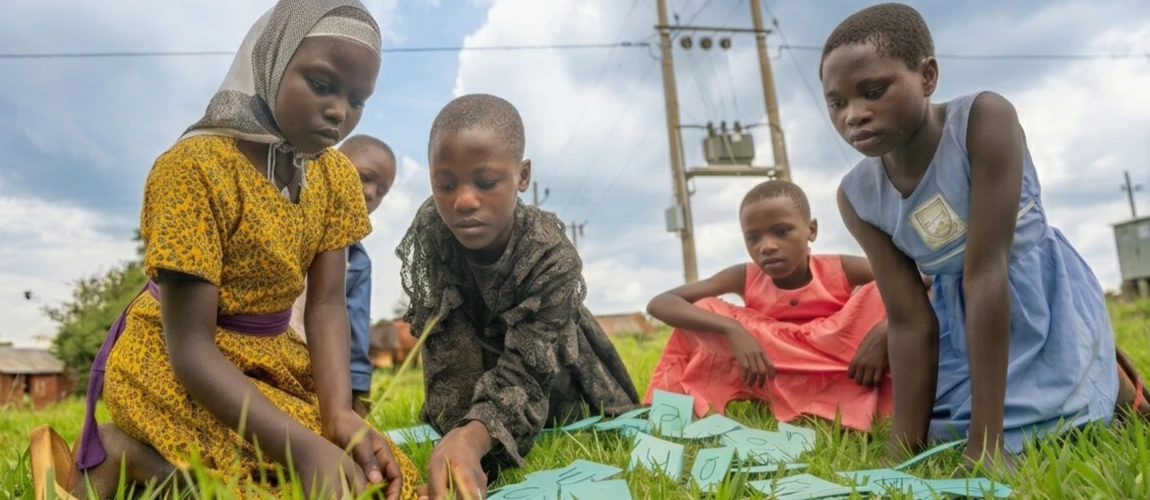
 Building Tomorrow's Roots to Rise program in Uganda trains community education volunteers to run short, structured cycles of reading and math practice. Copyright: Building Tomorrow
Picture a child sitting in a crowded classroom, copying words from a chalkboard—yet still unable to read a simple sentence on their own. At the World Bank, we call this learning poverty, and it is more common than it should be. In low- and middle-income countries, more than 70% of children cannot read and understand a simple text by age 10.
This is more than an education issue—it is a jobs and economic growth issue. When basic reading and math don’t take root early, everything that follows gets harder, including science lessons, exams, confidence, and eventually the path to employment.
With overworked teachers, overcrowded classrooms and limited time for individual support, many children fall behind in their early grades and simply never catch up. One solution is to train trusted local citizens to serve as volunteers, offering children the chance to practice reading and math skills beyond just the classroom. We call this “community-powered learning.”
How do we deliver skills to all children?
In many countries, leaders are making strong commitments to foundational learning. The hard part is turning those commitments into steady, on-the-ground support for the children who need it most.
That is where the World Bank’s Foundational Learning Compact (FLC) Accelerator Program comes in. The program supports countries in adopting evidence-based strategies (see the report, Smart Buys 2023) to align the instructional core—teaching practices, training, ongoing support to teachers, materials, and assessments—to accelerate progress on foundational learning. To scale up these approaches, countries also need to improve their delivery systems for lasting results.
Community-powered learning can be a key avenue to address delivery challenges. It asks a simple question: What if children had more chances to practice reading and math—guided by trusted people close to home?
By training and supporting trusted local people, such as caregivers, youth leaders, retirees, and other volunteers to run structured, level-appropriate activities, communities can add learning time, help children catch up using quick assessments and grouping by skill level, and reach children the formal system sometimes misses. Just as important, these efforts can produce light, actionable data—who is attending, who is progressing—that helps governments and partners learn what is working and where to adapt.
Roots to Rise in Uganda: Community-powered learning in action
Building Tomorrow’s Roots to Rise (R2R) program in Uganda offers one example. Instead of depending only on the hours in a school day, Roots to Rise trains community education volunteers to run short, structured cycles of reading and math practice—often after school and in local community spaces. The program melds targeted instruction and structured pedagogy to contextualize lessons and ensure learners are taught by ability level and tested for comprehension.
Building Tomorrow reports that in one 40-hour cycle, the share of participating children reaching minimum proficiency in literacy and numeracy increased substantially. The model builds in choices that make it repeatable: Simple learner checks, clear routines, short cycles, volunteer training and coaching, coordination with schools, and light-touch monitoring to protect quality and equity.
These insights from Roots to Rise can help countries move from plans on paper to learning gains at scale:
- Meet children where they are: Quick checks help group learners by skill level (not grade), so practice targets what will move them forward.
- Keep it short and focused: Time-bound cycles with familiar routines make it easier to deliver well and to adjust quickly when something isn’t working.
- Support volunteers well: Training, coaching, and simple tracking of attendance and progress help protect quality and children’s safety.
- Stay aligned with schools: The strongest programs coordinate with teachers, reinforcing classroom goals and strengthening school–community ties.
A strategic opportunity to accelerate learning
The challenge is real: Learning poverty is still far too high, and budgets are tight. But there’s a practical path forward—community-powered programs that focus on the basics and do it well. When they’re built on proven approaches like R2R, backed by solid training and regular check-ins, and led by people in the community, they can deliver quick gains, reach learners who are too often left behind, and strengthen the national education system at the same time. Most importantly, they give students the foundational skills they need to succeed in work and life—turning “it takes a village” from a nice saying into real momentum for skills and jobs.
Join the Conversation