
Facing a shrinking workforce and stubborn stagnation in 2012, Japan placed a pragmatic bet on women. It rolled out a series of reforms to make it easier for women to work, including expanding childcare support, enhancing parental leave, and using tax incentives to spur firms to promote women at work. By 2019, two million more women were employed, female labor force participation reached 67%, and job placement for graduates was nearly universal.
Developing economies face the inverse challenge: a massive youth bulge, with 1.2 billion young people entering the market over the next decade. Yet the solution remains the same: mobilizing women. It seems counterintuitive to focus on inclusion when jobs are already scarce, but women don't just fill roles - they create them. Through leadership and entrepreneurship, women act as economic multipliers.
The potential returns are staggering. Closing the gender activity gap could boost GDP by up to 20% in most nations — turning a social necessity into an economic engine.
The takeaway is straightforward: when constraints on women’s participation fall, economies become more dynamic and more resilient. Yet, in many countries, these hurdles persist — both in the law and in the policies and institutions that give laws their force. The Women, Business and the Law 2026 report is a useful diagnostic tool that tracks laws on the books, the policies in place to implement it, and how effectively they work in practice.
Global State of Women’ Economic Rights
Only 4% of women live in economies with nearly full legal equality; globally, women worldwide hold just two-thirds of the legal rights granted to men. Even where legal protections exist, just 47% of the policies and services required for implementation are in place. A new enforcement index reveals these laws are applied about half of the time, leaving a massive gap between legal rights and lived reality.
Progress, Gaps and What’s Missing
Today, not a single country provides women with the same legal environment as men across all ten Women, Business and the Law indicators: Safety, Mobility, Work, Pay, Marriage, Parenthood, Childcare, Entrepreneurship, Assets, and Pension. The biggest gaps are in Safety (protection from violence), Entrepreneurship (starting and operating businesses), and Childcare (availability, financing, and quality of services).
In the area of Safety, while 143 economies prohibit sexual harassment in employment, only 90 prohibit such behavior online, 63 prohibit sexual harassment in education, and merely 36 have laws addressing sexual harassment in public spaces. When it comes to Entrepreneurship, only 99 economies promote women’s equal access to credit and just 40 economies have introduced mandatory minimum representation of women on corporate boards. In Childcare, 146 of 190 economies regulate childcare services for children under 3, but fewer than half (78) offer financial or tax support to families; only 66 set comprehensive quality standards (e.g., caregiver-to-child ratios, maximum group sizes, education or training requirements, periodic inspections or reporting requirements).
Encouragingly, reform momentum is emerging in areas where barriers are greatest. In the area of women’s safety, 24 reforms were recorded across 22 economies, led by Latin America and Caribbean. Six economies — Belize, Bolivia, Bulgaria, Peru, Suriname, and Zambia – raised the legal age of marriage or removed parental consent exceptions, closing loopholes enabling child unions. Seven economies — Argentina, Brazil, Mali, San Marino, Sri Lanka, the United Kingdom, and Uruguay — introduced or strengthened cyberharassment laws to combat online violence.
The area of entrepreneurship also saw progress, with 21 reforms across 19 economies. For example, Suriname’s Trade Register Act now lets women register businesses in the same way as men do, removing a long-standing structural barrier. Ecuador’s Law to Promote the Economy of Ecuadorian Women Entrepreneurs bans gender-based discrimination in credit evaluation, adds oversight, and introduces sanctions for noncompliance. Thirteen economies strengthened women’s representation in the private sector by introducing or reinforcing gender quotas on corporate boards.
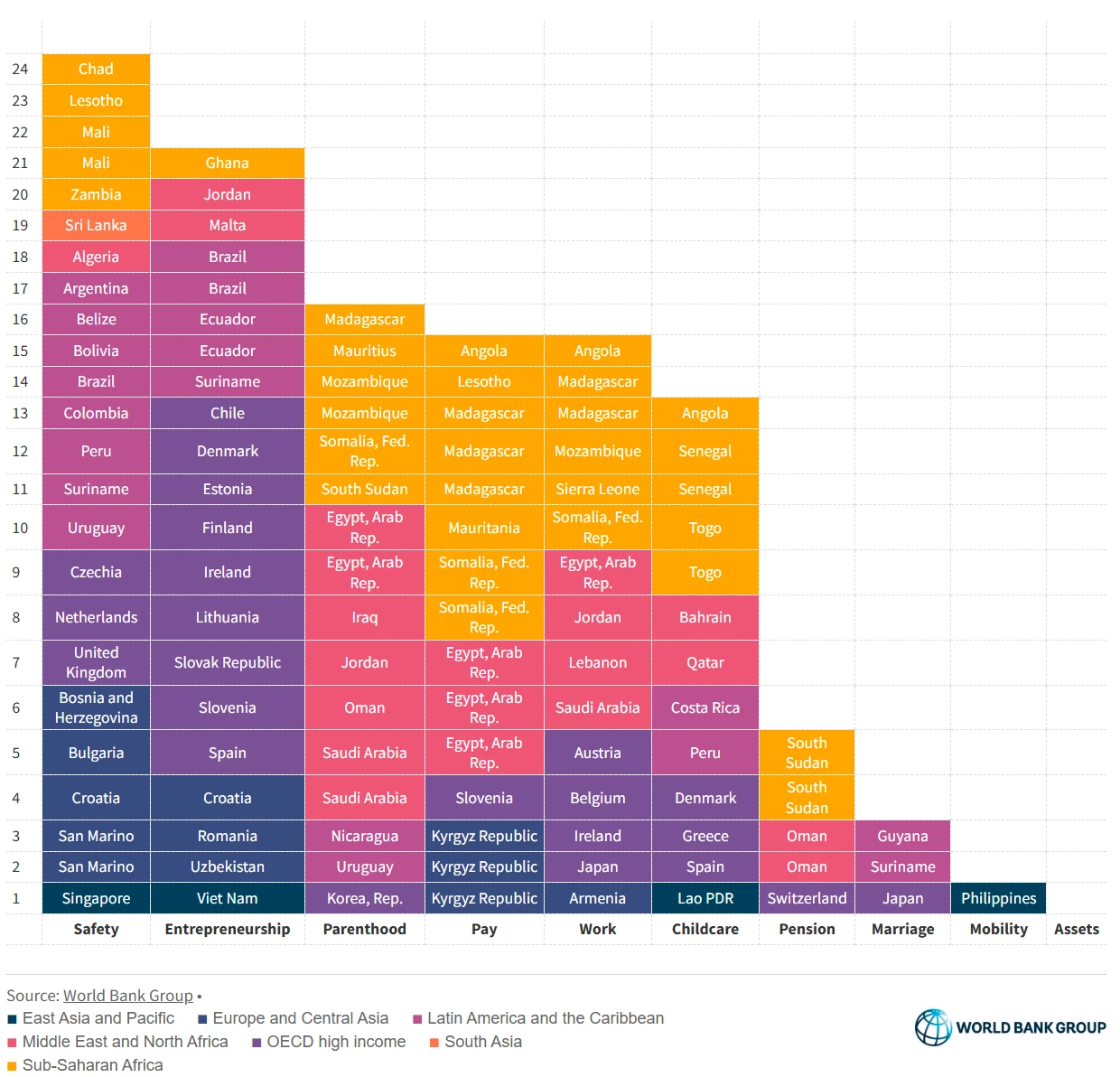
However, progress is uneven, not only in the law but also in its implementation. Economies around the world have enacted necessary laws but struggle to implement them. Gaps in policies, services, and institutions needed to implement laws are most acute in Assets (property and inheritance), Pay (occupational segregation and wage gaps), and Parenthood (support during and after pregnancy). This highlights the need to invest in institutions and compliance mechanisms such as property registries, monitors of equal pay, and childcare systems.
Turning evidence into progress
If the goal is more jobs and stronger economic growth, the agenda is clear: eliminate the constraints to women’s full participation and build systems that work for everyone. Data from Women, Business and the Law 2026 will drive public awareness and pinpoint exactly where policy changes are needed. Governments, employers, and civil society must unite to translate this evidence into reform - and reform into economic gains for all.


Join the Conversation