
 Careful program design is essential to ensure that public resources translate into real gains in jobs and SME growth. | © Shutterstock.com
Governments around the world spend billions of dollars each year to help small and medium-sized enterprises (SMEs) access finance. The goal is clear: more credit should allow firms to grow, hire more workers, and contribute to economic diversification. But do these programs actually work? And does the way they are designed matter?
New evidence from Kazakhstan shows that program design matters a great deal. Comparing three widely used policy tools within the same country, we find that some costly programs have little impact on firm performance, while others yield large gains in employment and sales when incentives are properly aligned between lenders, borrowers, and the government.
Why governments support SME finance
SMEs play a central role in job creation and innovation, yet they often face difficulties in obtaining credit. Banks may be reluctant to lend to smaller firms because they lack collateral, have shorter credit histories, or operate in riskier sectors. To address these constraints, governments commonly use two types of financial support: (1) interest rate subsidies, which reduce the cost of borrowing for SMEs, and (2) credit guarantees, which reduce the SME credit risk for lenders by covering part of the loan in case of default
These programs are used in both developed and developing countries, but comparing their effectiveness is not straightforward. Results from similar interventions in different countries are hard to interpret, because differences in banking systems, regulations, and firm characteristics make it unclear whether outcomes stem from the program design or from the context in which the program was implemented. We address this challenge by comparing three SME support programs side-by-side within the same country, Kazakhstan, holding the institutional setting constant and isolating the effect of design choices.
Comparing three state SME programs
Using administrative data covering the universe of firms in Kazakhstan, we evaluate three large government programs implemented through the development finance institution DAMU:
- Interest rate subsidies (IRS): the government reimburses part of the interest payment to the borrower after the loan is issued.
- Fully subsidized credit guarantees (SG): the government covers guarantee fees and assumes a large share of the risk, leaving lenders with little exposure.
- Market-aligned partial guarantees (DOG): firms pay a fee, and lenders retain part of the risk, incentivizing lenders to screen borrowers carefully and target firms with genuine growth potential.
Because these programs were rolled out at different times and regions, we estimate their impact using a staggered difference-in-differences approach and track changes in full-time equivalent employment and sales.
What do we find?
Interest rate subsidies do not improve firm performance. SMEs receiving subsidies do not increase sales, and employment actually falls by about 10 percent on average (Figure 1-Panel A). One explanation is that, in Kazakhstan, these subsidies do not change banks’ incentives to lend to more constrained firms. Instead, they often act as transfers to firms that would have borrowed anyway, without easing access to credit.
Fully subsidized guarantees also show little impact. When lenders bear very little risk, they have weaker incentives to screen borrowers, and the program does not translate into stronger SME growth.
The picture changes when guarantees are designed to preserve risk-sharing. Under the market-aligned partial guarantee program, firms pay a fee, while banks retain a share of the credit risk. This structure encourages better screening and targeting of firms that can grow if given access to credit.
The results are striking: employment increases by about 24 percent (Figure 1-Panel B), and sales increase by about 21 percent. Interestingly, the effects appear to grow over time and are concentrated among formally registered firms and women-led businesses.
Figure 1. Impact of the IRS and DOG programs on the average employment of firms
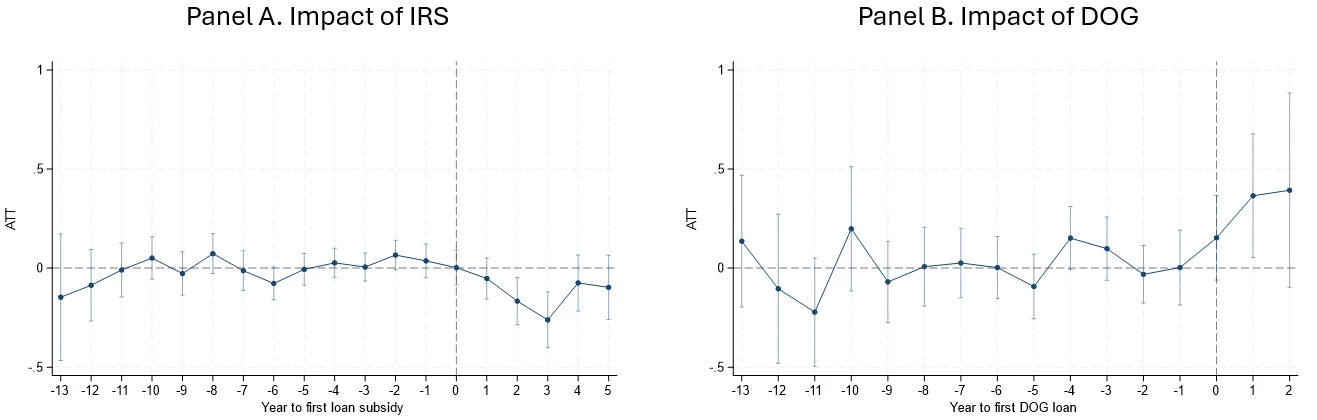 Notes: The figures plot the Callaway and Sant’Anna (2021) estimates of yearly pre- and post-treatment effects of the IRS (Panel A) and DOG (Panel B) programs on firm employment, averaged at the industry-location-year level and reported in logs. The sample consists of industry-location pairs where each program was rolled out from 2012 to 2019. Estimates were generated using the event_plot command in Stata, with standard errors clustered at the industry-location pair level. The vertical lines correspond to the 95% confidence intervals.
We also find that local labor markets shape program effectiveness. Employment gains from partial guarantees are much larger in regions with higher pre-program unemployment, where firms can hire new workers without simply drawing them from other employers. This suggests that in these areas, the program creates net jobs rather than reallocating them, an important distinction for policymakers focused on aggregate employment.
Lessons for policymakers
Three main lessons emerge from the evidence.
- Design matters more than spending. Large subsidies do not guarantee large impacts. Programs that weaken incentives for lenders or borrowers may generate high fiscal costs with little effect on growth.
- Risk-sharing improves results. Guarantee schemes that require both lenders and SMEs to bear part of the risk are more likely to extend credit to productive firms.
- Initial conditions matter. Programs aimed at job creation are more effective in areas where firms can expand employment without displacing workers elsewhere.
While this evidence comes from Kazakhstan, the underlying logic applies wherever governments run credit guarantee or subsidy programs to support SMEs, either during periods of economic uncertainty or as part of their industrial policy. Our findings suggest that careful program design is essential to ensure that public resources translate into real gains in jobs and SME growth. These dynamics are relevant to program designers in middle-income and developing economies alike.
In line with these lessons, Kazakhstan — supported by the World Bank — is reviewing its SME support programs to expand the use of guarantee schemes with stronger built-in accountability for lenders and borrowers.


Join the Conversation