
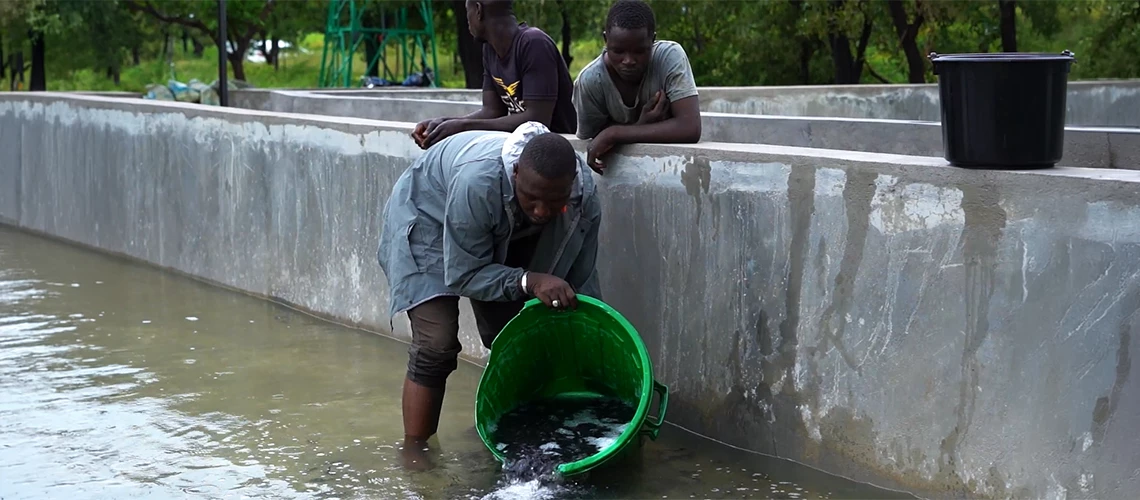
 Fish farming pond. Credit: PRTD-MALI.
After spending several years studying aquaculture in China and Japan, Moussa Samake came back to Mali only to discover the lack of opportunities waiting for him. The Sahel — defined by its arid landscapes, long dry seasons, and cycles of uncertainty — seemed an unlikely place to farm fish. Jobs were scarce. Young men spent their days at the grin, the traditional social gathering spots that have become, for many, a symbol of idle waiting in a region short on prospects. For a trained aquaculture specialist, the gap between ambition and reality could not have been wider.
"Where there once reigned unemployment and discouragement," Moussa recalls, "there is now hope, employment, and local economic dynamism."
That transformation did not happen by accident. It happened because the right investment reached the right person at the right moment — and it points to something larger: a quiet blue revolution taking root across the Sahel.
A Historic Shift — But Africa Is Being Left Behind
The world has crossed a significant threshold. For the first time in history, aquaculture has surpassed capture fisheries as the primary source of aquatic food, now accounting for 57% of global production. Since 2000, the sector has grown by 455%.
Africa has largely missed this wave. The continent contributes just 1.9% of global aquaculture output — a striking gap given that sub-Saharan Africa is home to some of the world's fastest-growing populations. With per capita fish consumption projected to decline unless local production is dramatically scaled, the stakes could not be higher. Aquatic foods already provide 18% of animal proteins consumed in Africa — above the world average — making fish not a luxury but a nutritional lifeline.
The issue isn't about potential, it is the structural bottlenecks that stall investment: high production costs, weak infrastructure, policy gaps, and a shortage of skilled human capital. Moussa Samake represents exactly the kind of talent that exists in the region — and that, without the right support, goes untapped.
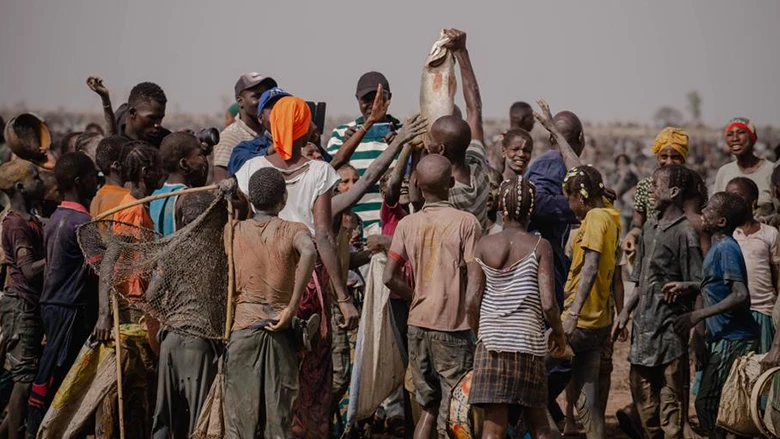 Sanké Mô collective fishing in the Sanké pond, practiced in San (Mali). Credit: PRTD-MALI.
From Dream to Enterprise: The PRTD-Mali Story
Through the Mali Degraded Land Restoration Project (PRTD-Mali), supported by the World Bank's Sahel RESILAND program, Moussa's project moved from a proposal submitted via social media to a thriving operation. His farm in Ferekoroba now houses over 12,000 fingerlings and delivers high-quality protein to a community that previously had to travel seven kilometers to find fresh fish.
The farm is more than a production site. It is converting degraded land into a productive economic asset, creating specialized technical roles for young men and building out a processing workshop that will soon employ twenty women.
According to FAO data, women already make up 62% of the aquaculture processing workforce in the region — a figure that the project is actively building on by equipping women with modern preservation tools and formal employment.
For Moussa, receiving support through this process was, in his own words, "a call of happiness” not just a business opportunity, but a restoration of dignity and purpose in a region that had offered him neither.
Scaling the Model: From Mali to the Wider Sahel
The project is not a one-off success story. It is becoming a blueprint. The World Bank is currently conducting a comprehensive sectoral diagnosis — known as PASA (Programme d'Appui au Secteur Aquacole) — to identify the infrastructure gaps and policy barriers that have historically constrained aquaculture growth across the region. The goal is to develop a clear Investment Pathway and Guide: a technical roadmap for replicating the PRTD-Mali model, beginning with the specific contexts of Mali and Niger, where the model is already demonstrating results.
That momentum is spreading. The PASA work has extended into Chad and is generating strong interest in Burkina Faso, where structured aquaculture investment is increasingly seen as a tool for economic stabilization. More broadly, under the World Bank's AgriConnect initiative, governments across West Africa are requesting targeted investment to make aquaculture a strategic pillar of job creation and resilience — combining the Bank's technical expertise, capacity building through the IFC Agribusiness Leadership Program, and investment funding.
As Moussa himself puts it: "The PRTD-Mali embodies a model of success and good governance that we wish to see multiplied throughout the country."
Job creation sits at the heart of this ambition. Agribusiness is one of five sectors the World Bank has identified as having the greatest potential to create local jobs — and aquaculture is emerging as a powerful driver within it.
By investing in value chains that connect smallholder producers like Moussa to processors, traders, and consumers, the World Bank is helping countries build economies that convert growth into local jobs, unlocking opportunity where people already live.
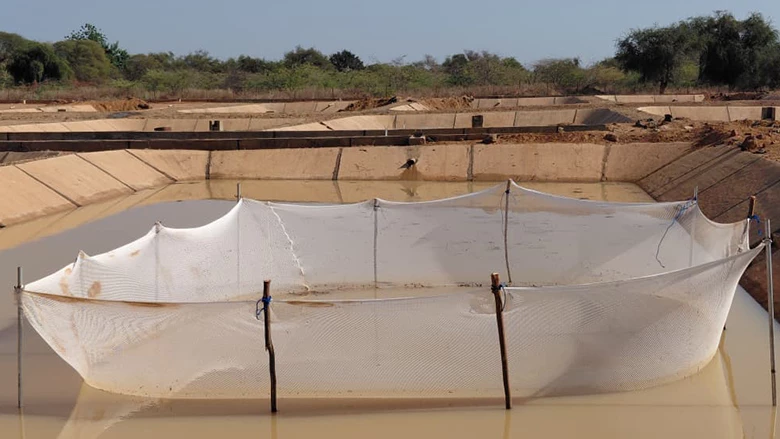 Site of a productive alliance beneficiary following the delivery of fingerlings. Credit: PRTD-MALI.
A Brighter Future, Farmed from Dry Land
The Sahel faces real and compounding pressures — climate shocks, food insecurity, demographic stress, and fragility. But Moussa Samake's story is a reminder that solutions can be found in unexpected places, and that transforming vulnerability into resilience is possible when investment is strategic and human capital is taken seriously.
******

Join the Conversation